20 January 2012

Fighting High flying high

In this age of e-books and online resources you’d think anyone who started up a new, specialist publishing company to produce real, tangible, high quality books would need their head read. With some authors preferring to make their work available in electronic form, and the media screaming the end of paper books is nigh to whoever will listen, it would certainly seem a risky venture. Established and respected author Steve Darlow, however, had other ideas and, with a good network of fellow authors and interested parties, saw the opportunity to try a few things that were a little bit different.

A perfect example of this is the recent announcement that the official book of the Bomber Command Memorial, currently being constructed in London’s Hyde Park, will be designed and published by Fighting High Publishing. We Will Remember Them – The National Memorial to Bomber Command is quite a coup for the Darlow-led publishing house as it was only back in about June 2009 – not long after the release of his challenging Flightpath To Murder by Haynes - that the decision to self-publish Steve’s Fighting High book series was made.

Since then the business has made a name for itself by producing books with high production values. Like all publishers considerable effort is put into the look of each title and the results speak for themselves. Following the publication of the two Fighting High volumes the first ‘stand-alone’ title was released. Richard Pinkham’s On Wings Of Fortune, a remarkable story of flying in three different theatres during the war, was proudly presented as a small, 200-page hardback. The way it was put together – from the glossy dust cover to the well-reproduced photos from Burma (always a fun thing to print given the humid conditions in which the photos were taken) – still impresses me. It just looks right.

This attention to quality of production continued with the next book – Great War To Great Escape (incidentally, the only FH book I have read to date and soon to be featured in a review here). However, as good as these books are, they were always going to be in competition with the, admittedly and fortunately, well-populated aircrew memoir market. The next two books from Fighting High are, from where I sit, groundbreaking and in a class of their own.

Portraits Of The Few features paintings of more than 60 Battle Of Britain veterans accompanied by accounts of their actions in a large-format hardback. While using paintings to illustrate text is nothing new the portraits make for a very personal and striking look at the contribution these men made to a conflict that continues to stir emotions today. Indeed, the intimacy provided by the paintings could perhaps only be matched by a memoir written by one of the men themselves. The book offers, in many cases, the first opportunity to see these men, during their finest hour, in ‘living colour’ – a stark contrast to the black and white war we are all accustomed to.

Matching Portraits’ quiet emotion and intimacy with stories of loss and sacrifice is Bomber Command: Failed To Return. An ensemble cast of well-known authors has come together to present accounts of just some of the thousands of bomber crews who were killed or became prisoners (those who failed to return). Such ‘short stories’ are usually the realm of historic aviation magazines but putting them all together in, again, a large format hardback means men whose exploits may not have come to light now get the recognition they deserve. Like the Bomber Command Memorial mentioned above this is a powerful tribute that owes its existence to a team of dedicated people.

As you might imagine the memorial has featured heavily in Fighting High’s recent history. Veteran and author signings have been held at book launches and as standalone events with proceeds from the latter going towards the well-known fundraising efforts for the memorial. Fighting High’s passion for honouring the bomber crews is evident and, coupled with the already well-established reputation for quality mentioned above, would have made the task of selecting a publisher for the memorial’s book that much easier.

2012, however, is not just about one new book. The success of Failed To Return has spawned a sequel that will no doubt do well with the added ‘bonus’ of the increased interest in Bomber Command as the new memorial is completed. A return to the Battle of Britain and a foray to Malta will come with the June release of ‘Tich’ Palliser’s They Gave Me A Hurricane – a book written by the man himself but, sadly, unpublished at the time of his death late last year. It is the reprinting of a classic biography, though, that will prove the publisher’s commitment to do things right but mix it up a little.

Pathfinder Cranswick was written by journalist Michael Cumming in the early 1960s. Over 40 years it has appeared in several guises, the most recent paperback being self-published. Wanting to keep the story fresh and keep the name of Alec Cranswick (bomber pilot who flew the most ops) ‘out there’, the author researched new material and created an e-book for sale on Amazon. The book has always been regarded as one of the classic Bomber Command biographies so Fighting High, realising the opportunity to bring the book back in its 50th year, has teamed up with Cumming who, again, has discovered further new material to include in the anniversary edition. This, obviously, is more than just a simple reprint with a fancy new cover or, god forbid, a new title. This will be a classic updated and fresh and at an affordable price which is more than can be said for the old editions on the secondhand market!

You may be wondering why I’ve gone to great lengths to promote one publisher seemingly over the others. There is no favouritism or ‘preferred’ publishers on ABR but credit where it is due. What I have seen over the past few years, from the start of Fighting High to the current success, has been an ability to think a little differently and challenge what is expected of a publisher in this genre. The desire to contribute to the memory of aircrew beyond peddling a product is commendable. High quality, the utmost respect and honouring the memory of aircrew should be paramount with these books and Fighting High does it exceptionally well.

03 January 2012

Understanding an addiction


I think the definition of an addict has in it somewhere the performance of actions that, upon reflection, the afflicted person can’t quite remember doing. Hi, my name is Andy and I’m a book addict. I had a package arrive today (actually there was two of them but let’s not go into details) and, for the life of me, had no idea what book (books) was in it (them). It doesn’t help that I regularly buy books from overseas and the cheap postage attached to the price often means I have to wait up to three months for the surface mail. So be it, it works out in the end. I guess that makes me a cheap addict too.

Anyway, I didn’t recognise the sender of the bigger package and, upon opening it, noted what was a hardback peering out between the gaps between the bubbles of the packaging material (another benefit of being an addict … bubblewrap!). The cover, see below, immediately took me back to early October when I had discovered the existence of yet another Fleet Air Arm memoir I had not heard of. Somehow, again, I have no idea how, I had stumbled upon proof of the existence of Norman Hanson’s Carrier Pilot. As alluded to in the previous ABR post below, I do tend to Google such things so it was not long before I had educated myself and decided this book was a worthy investment if I could find an affordable copy. As much as I love books, I refuse to pay exhorbitant amounts for them (although on very rare occasions I have spent close to A$100 for a thick A4-sized hardback) preferring instead to spread my budget over three, four or even five or six titles (and not all brand new). I guess that makes me a wise addict.

Obviously I managed to find an affordable copy – either that day or striking it lucky with a quick Abebooks ‘Want’ notification I honestly don’t remember – but that is about where it all ends until today. In the hustle and bustle of ‘managing’ the various responsibilities of having a pregnant wife, a birthday, a new niece and the festive season the fact that I had a worthy addition to my collection steaming its way (I suspect with less class and purpose than the author’s HMS Illustrious but with class and purpose all the same) across the high seas completely and utterly flew out of my head. If anything, the thrill of the chase was over and I had moved on. I guess that makes me a fickle addict.

This edition of Carrier Pilot is the 1979 printing by Patrick Stephens Limited (ISBN 0 085059 349 2). Ordinarily I don’t go for books this old – the early ‘80s is usually my cut-off (I know, I’m missing out but one has to draw the line somewhere … so it can be crossed…) – but I am certainly glad I did. With a dust jacket illustrated by Michael Turner and, amazingly, flaps that are almost as eloquently written as the main text, I began to wonder if I had found a ‘forgotten’ classic. I read the first few pages as the front flap suggested and a mild sense of euphoria washed over me. Hanson can write. I guess that makes me a lucky addict.

I have spoken about the use of a dramatic moment from the featured person’s life at the start of the book as an excellent tool to hook the reader. Once the potential reader is attracted by the siren-like call of the cover, only photos and a well-placed ‘kicker’ can suck someone in (I’m generalising). Tim Vigors does it well when he describes the end of his combat flying career at the start of Life’s Too Short To Cry. Equally dramatic is Phil Davenport’s running battle with several Ju-88s in a Sunderland over the Bay of Biscay in Hurrah For The Next Man (reviewed December 2011). And so Hanson does the same although his book appeared on the shelves a good 20+ years before the two examples mentioned above. The chapter is titled "Suddenly there was gunfire…"

Our hero runs to the port side portholes as the carrier’s guns open up on fast and low Betty bombers. Sticking his helmeted head out of the port hole, Hanson has a front row seat before suddenly realizing he was literally sticking his neck out. Trying to pull his head in, he realises his helmet was stuck on the outer rim of the porthole. A nearby explosion forces his entire body back inside – “my head came inside without any trouble, almost pulling in the port-hole with it.” Just as you’re almost chuckling at this scene there’s a shout from a colleague:

Come on, Hans! Stretchers!

Two shells from the cruiser Euryalus had hit the carrier’s island and the shrapnel had rained down on the men man-handling two Grumman Avengers down the deck. Hanson doesn’t say it but his descriptions of what he finds on deck must have happened in slow motion. You can see it and you can feel his shock.

The bos’n, one Charlie Hobbs, notices Hanson’s understandable daze.

Come on, Hans, for God’s sake! Move these lads up against the island!

Hanson reacts:

I caught up the legs of one body and pulled it, slowly and tenderly, to the high, grey wall of the island. I just felt sad – oddly enough, not sick. Just unbelievably sad.

‘Oh! For Christ’s sake, Norman!’ (My Sunday name now!) ‘Get a bloody jerk on, son! Those bastards’ll be back any minute!’ Charlie was grabbing them by the ankles and fairly hurling them across the deck. He looked up and saw my face.

‘Don’t let it worry you, Hans,’ he said, surprisingly gently and softly, despite the rumpus that seemed to fill the deck. ‘They can’t feel anything now, you know. You can’t hurt them any more.’

What a great man you are, Charlie, I thought. Somewhere along the years you will tell them that you were the bos’n of Illustrious and some smooth bastard who knew the sea only from kicking pebbles into it from Southsea beach will say ‘So what?’ No one but your shipmates will ever know what a sterling character you really are.

That evening Charlie was sewing those mangled kids into tarpaulin sheets.

I’ve left out some of the descriptions of the carnage of course as it is not pleasant but it is written in a way that strikes to the core. How can a book start off with quite dark humour – the helmet stuck in the porthole while under fire – and then, less than a page later, actually hurt to read before marveling at the bravery and humanity of a man in a most dire situation? This chapter is a little over three pages long yet my emotions were all over the place. Not since Murray Peden’s A Thousand Shall Fall have I been so stunned by so few words read (and Peden’s opening elicited a snigger and then full-blown laughter in the first two pages so is really at the other end of the emotional spectrum).

I’m sitting here trying to think what to write next to expand on what I’ve discovered and am trying to, somewhat clumsily, convey. I’m a hopeless addict. Really, since he started it all, the last words should be Norman Hanson’s as they echo what is at the very heart of spreading the word about aircrew books:

That evening, as we cruised slowly south-eastwards, 100 miles or so from the coast of Sumatra, we buried them. Our great ship slowed down to six knots. George Fawkes read the Burial Service, standing beside that silent row of Union flags. One after another the boards were tilted and the hammock-like tarpaulins slid swiftly and quietly into the Indian Ocean. The plaintive notes of the bugle rang out over the great waste of water and they were gone. We could do no more than hope to remember them.

02 January 2012

Serendipity

There I was innocently beavering away at work when I felt the need to stretch. It would not surprise you, as my arms reached out to either side and my head tilted to the ceiling, that something very book-related popped into my head. "I wonder if there's any reviews for The Amiens Raid yet?", I thought. When I have a new book in my collection, and I know I'm not going to read it for some time, I'm always interested to see what the word is on the 'street' from those who have had already had the chance to get stuck in.

In the case of The Amiens Raid - Secrets Revealed by JP Ducellier, I came up dry but only after visiting artist Mark Postlethwaite's website and discovering he is co-owner of the publisher of TAR (Red Kite Books). Amazon didn't look too promising from the Google search but my curiosity got the better of me. There were no reviews to be found but I scrolled down somewhat absent-mindedly (automatic pilot?) and my heart skipped a beat when I saw the following text:


The author? The one and only Christopher Shores. I had heard several years ago that the classic (and pricey!) Shores titles like Fighters Over The Desert were being revised and/or reprinted. Thinking these titles would come out singularly as they were updated etc, it is apparent from the Amazon 'blurb' that this one title (over several volumes) proves my theory completely and utterly wrong. If anything, this series will be a stand-alone collection using the earlier books as its foundation and presenting a 'one-stop shop' through the employment of further research, new resources and a theatre-wide scope. Exciting, yes? Not a bad result for an idle thought about a somewhat unrelated book!

By the way, that's volume one of just North Africa. Malta, Sicily, greater Italy, Greece, the Aegean and the Balkans will be forthcoming!

24 December 2011

Season's Greetings

It's rapidly approaching the end of Christmas Eve down here so I'll take this opportunity to send a quick Merry Christmas greeting to everyone who has supported ABR this year. I hope this finds you and your loved ones safe and well and ready for what will be a happy new year. We're expecting our first child so 2012 will certainly be a momentous year for ABR HQ.

Thank you to the authors, publishers, family members and fellow enthusiasts for your correspondence and enthusiasm for supporting ABR's mission to help spread the word of the exploits of the aircrew we admire so much.

May the new year bring you all health and happiness and a few new books that will fascinate, inspire and educate.

Cheers!

Andy

10 December 2011

Hurrah For The Next Man - Phil Davenport

Time marches on and we’re simply along for the ride. It, however, gives us the chance to live and grow … or live and learn. Its passing yields experiences too many to count and each of these shape our opinions and views of the world. Many people, through the wonders of technology, publicise their opinions and, more often than not, these published words, qualified or not, are at odds with the views of others. Fair enough. If we were all the same it would be a pretty boring world but are there some writers we should listen to more than others? In relation to war – and you know where I’m going with this – those who have been there should be heard. Phil Davenport, author of Hurrah For The Next Man, is certainly qualified to argue against the sacrifice of good men. I was caught off guard by his apparent initial cynicism (perfectly captured in the title) and disagreed with some of his jaded comments. However, as I read on I realised it was my fortunate naivety – thanks to men such as PD – that clouded my initial judgment. When Phil Davenport talks of the futility of war, or of a Sunderland flying boat under attack from German heavy fighters, we should all listen.

The reader is immediately aware of Davenport’s ‘qualifications’ when he opens his wartime account with his crew’s running, uneven, fatal battle between their No. 461 Squadron RAAF Sunderland and Luftwaffe Ju-88s. A dramatic account is a useful tool to hook a reader and it is employed well here. While, naturally, told out of sequence it perfectly illustrates the threats to the long-range Coastal Command crews. The reality of flying the Sunderland is laid bare and this action – indeed, this ‘environment’ when the Germans countered the defensive successes of the ‘boats with flights of heavily armed long-range fighters – sticks in the back of the reader’s mind.

Growing up in Sydney with two younger brothers Davenport keeps a ‘weather eye’ on the various political and military posturings around the globe. Quite worldly, as a result, his volunteering for service is inevitable. His two brothers also join the air force and the reader is given a brief window into the trepidation of a family (and community) sending its sons to war and then waiting for a telegram that hopefully never comes.

Unlike his brother Jack (future No. 455 Squadron RAAF Hampden and Beaufighter pilot) PD only completes his initial ground training in Australia before sailing for Southern Rhodesia via a decidedly unwelcoming South Africa.

Six weeks of Tiger Moth flying and another 14 in the Harvard has the author graduating and returning to South Africa for a Navigation and Reconnaissance Course. His time learning to fly is told matter-of-factly with equal space given to his experiences on the ground and observations of the social aspect of life in Southern Rhodesia. His life in South Africa proceeds similarly before embarking for the UK to eventually arrive in February 1942. Two months later, having reunited with his brother Jack on several occasions, Davenport has his first flight in a Sunderland and, after a few episodes of ‘gale watch’ aboard moored aircraft, is soon in the thick of it as a flying boat second officer before, after three months, becoming a permanent first officer. His ‘welcome’ to the world of Sunderlands consisted of anti-shipping strikes, bad weather, U-boat sightings and successful encounters with enemy fighters. All this and not even close to being halfway through his tour of 800 hours or 75 ops! All adventures are written with an eye for detail – particularly descriptions of weather and sea conditions – and more than a little wry, unintentional humour e.g. in a stalled Sunderland coming out of an updraught and experiencing negative G, the author on the flight deck with his head “pressed against an overhead panel” used “both feet to line up the throttles.”

Leave, ferrying an aircraft to a dismal servicing depot in Scotland and then having to endure six weeks at said depot waiting for said aircraft to be finished eventually led to another series of patrols that culminate in a night take-off accident the crew are lucky to survive when a surging, and ultimately seizing, engine causes the Sunderland to cartwheel into the water just short of a stone jetty. Davenport’s luck holds as he is later involved in a successful attack on a U-boat before being given his own Sunderland to command. Six patrols later the crew are engaged by the six Ju-88s in the action that introduces us to Davenport’s flying boat war at the start of the book. They return to operations after survivors’ leave in late August 1943 and immediately encounter 88s again but are, happily, saved by Mosquitos. The use of Mosquitos over the Bay of Biscay was partly in answer to the threat of the Ju-88s.

Tiredness, in mind and body, took its toll towards the end of the tour and a momentary lapse of judgment had him lining the Sunderland up on the grass runway at Haverford West in order to give the place a good ‘beat-up’. This stunt, however, was witnessed by the Group Air Officer Commanding and Davenport was given the choice of a court-martial or, luckily, three weeks at a disciplinary school. The latter was chosen of course and proved to be surprisingly refreshing and constructive despite the best efforts of some of the ‘instructors’.

PD’s final landing in a Sunderland was on January 4, 1944 and he left 461 for an OTU at Alness, Scotland. His two weeks’ leave involved attending the wedding of his brother Jack (all three brothers reunited after youngest Keith had joined 461 just prior to PD’s posting) – also in Scotland. The ceremony and events surrounding this special occasion are lovingly told (see also Kristen Alexander’s Jack Davenport Beaufighter Leader).

This happy time continued into the author’s stint at No. 4 Sunderland Operational Training and Maintenance Unit although it initially looked as though he was in for a frustrating time. Commanding the ‘test flight’ section of the unit Davenport was in charge of a range of men who, in one way or the other, all resented being sent to a ‘backwater’ instead of an operational squadron or, in the case of tour-expired chaps, home. Maintenance was performed to a minimum standard with little or no responsibility taken. Displaying the leadership that came so naturally as a flying boat captain Davenport ensured proper sign-offs and independent checks of ‘completed’ work by technical aircrew. Slowly but surely the quality of work improved and the five months spent at Alness became the most enjoyable of his service.

Operational flying beckoned, however, and Davenport became a Mosquito pilot. The conversion from Sunderlands to Mossies is, surprisingly, not detailed beyond a photo of the course pilots. Perhaps there was no need as the author took to the de Havilland design like the proverbial duck to water. His affinity with the aircraft oozes from his writing and, experienced but indifferent navigator aside, there is every indication he was an effective strike pilot.

His thirteenth operation with No. 235 Squadron in April 1945, and the first with a new navigator who would save their lives, was also his last. Davenport and Ron Day are helped by local Norwegians before being interrogated by the Germans after crash-landing on a frozen lake. What follows is a necessarily short but detailed account of something you don’t read about too often – a POW imprisoned in Norway.

Finally making it home to Australia in September 1945, the author was uncertain of his future. What to do? The United Nations Relief and Rehabilitation Administration was considered a good place to try his hand and, by April 1946, Davenport was on his way to China to be a depot master for a canal project north-west of Shanghai. Perfectly suited to the role, he ultimately, somewhat unbelievably after so many years of war, found himself in another conflict – the Chinese civil war.

As Davenport’s career with UNRRA progressed in China so did the war. He was soon very much in the front-line and even found himself under fire again – this time from the air and from the banks of rivers he tried to navigate small ships through on supply runs. Surrounded by death, persecution and brutality he kept his head – figuratively and literally – to return to Australia at the end of 1947.

Already a man who did not suffer fools or bureaucracy lightly, Davenport’s experiences in China appear to have had the most profound affect on his view of the world and it shows throughout his writing. At times his apparent cynicism comes across as a little too much but, as alluded to in the opening of this review, his opinion is, more than anyone else’s on this occasion, completely justified. The book is most definitely written looking back through 60+ years of life with any ‘innocence of youth’ decidedly absent and replaced by a well-honed and earned weariness with those who govern us. Observant of the world around him, Davenport is not a stereotypical Australian with a healthy disrespect for authority. Instead he has a disdain for inequality and for those who would not get their hands dirty or sought to feather their own nest ahead of any compassion for their fellow man.

HFTNM is the first flying boat-based book to feature on ABR. Indeed, it is the first Sunderland book I have read in a very long time. How it compares to others in this area I cannot say. Certainly not technical in its delivery, with a distinct lack of ‘numbers’, the writing provides a good idea of what it was like to fly (and fly in) one of Short Brothers’ finest. Flying the big aircraft into combat is related in an easy, flowing manner. In some cases not a lot is written about particular events but none are lacking on detail with Davenport writing efficiently and effectively. Initial physical inspection of the book is misleading as there is plenty of detail – not just of his flying but also of the good men he served with – throughout. It is said maritime patrols consist of long hours of boredom punctuated by brief moments of sheer terror. If anything, Davenport, in his first tour, experienced more than his fair share of the latter.

Very few of the books relevant to ABR glorify war. In fact it is probably fair to say none do. However it is easy to get wrapped up in the action and hi-jinks that pervaded the lives of aircrew and become somewhat addicted to these rollicking tales. The ‘experienced’ reader knows, however, that, with absolute certainty, death, injury and loss are but a page away and that these aspects of the war were as much a part of an airman’s life as the combat and ‘play hard’ attitude. Living with such things hanging over you and realising you were just “one of those grains of sand or drops of water” would certainly lead to a questioning of the sense (or lack of) of it all. Never have I come across a book that illustrates this combined sense of helplessness and frustration at being put in harm’s way to do another’s bidding so well. Phil Davenport had a choice to go to war and did (and did it well). Many others since have had that choice made for them. That they have means, to some extent, we haven’t learnt a thing.

An attractive and well-produced paperback, HFTNM features more the 80 photos throughout the book printed on the same, high-quality semi-gloss paper as the main text. Footnotes are extensive and the four maps preceding the excellent index are clear and detailed and among the best I have seen in this genre.

Published by Beachcomber Press in 2009 in Tasmania the entire package is the perfect vehicle for Davenport’s story. I have seen it available in museums and some specialist bookshops (online and 'shopfront'). You can also contact the publisher at Beachcomber Press.

Review copy ISBN 978-0-9805265-0-9

07 December 2011

Owen Zupp online

Author and pilot Owen Zupp has launched a new website to showcase his aviation, writing and guest speaking expertise.

Since the publication of his highly-regarded Down To Earth (the first book featured on ABR) Owen's writing portfolio has gone from strength to strength. He is a regular contributor to antipodean stalwarts such as Australian Aviation and his work can also be found in industry heavyweights like FlyPast magazine. A former Tiger Moth owner and the brains (and 'muscle'!) behind There And Back - the Royal Flying Doctor Service around Australia charity flight - Owen is the consummate aviation professional who knows his stuff and can get it down on paper in an entertaining and informative manner.

While the website offers but a window into the life and writings of Owen Zupp it also allows us to pick up on hints about his latest book projects. Now that is something to get excited about!

08 October 2011

The RAAF In Russia - Geoffrey W Raebel

You’d think by now, with the plethora of information out there, not to mention the archives that are available to the public, the release of new books featuring new material would become quite a rare occurrence. However with letters and diaries etc continuing to come to light this couldn’t be further from the truth.

The recent launch of The Amiens Raid is the perfect example of a book full of previously unpublished material. The forthcoming new edition of Pathfinder Cranswick, however, is an older book with new and updated material. It is the subsequent editions of books that, I reckon, prove you can’t keep a good story, or author for that matter, down. Just because an author finally has his/her work published doesn’t always mean the research on the subject matter stops. The more prolific authors are more likely to turn their considerable skills to a new project but many authors become true specialists in their chosen field and continue their passionate research. Often the publication of their work generates interest from readers who have additional knowledge and/or material previously undiscovered by the author.

Such is the case with the second edition of Geoff Raebel’s The RAAF In Russia. The original was the result of six years of Geoff’s work – and an interest stemming from listening to his father’s stories of No. 455 Squadron’s epic Russian adventure. Twelve years and even more research later, the second edition is a self-published paperback of 149 A4 pages.

Flying the Hampden, a type retired from Bomber Command, on anti-shipping torpedo strikes was not one of the ‘better’ jobs for a crew but it was a task carried out with dedication and skill. The very nature of torpedo work meant little time to recover the aircraft if it was hit during the run in (or post-drop). Any chance of a crewmember taking control of a Hampden with an incapacitated pilot was severely hampered by the narrowness of the aircraft’s fuselage and the virtual isolation of each of the crew – a particular disadvantage the Bomber Command crews (some of whom were now the torpedo crews) were only too well aware of. As is typical of these men they took the risks in their stride, just as they did the challenge of flying to Russia - a destination beyond the range of the Hampden - to help protect the Arctic convoys from German surface ship attack.

The author does not forget the groundcrew who, after a long sea journey, endured harsh conditions that made the simplest of tasks difficult. It was, even during such exceptional times, an epic journey by anyone’s standards ... and the author follows it every step of the way.

More than 120 photos and diagrams support Geoff’s narrative as he takes us to Russia and back. This is the book for the Hampden operations in Russia. There’s more on Geoff’s website and you can buy the book direct from him - RAAF In Russia


11 September 2011

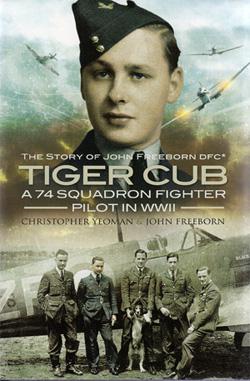
Tiger Cub - Christopher Yeoman and John Freeborn

Beginning in 2007 the book jumps back to 1938 with Freeborn arriving at Hornchurch not very sure of himself. The ensuing chapter describes Freeborn’s start as a fighter pilot. The Battle of Barking Creek is covered with Roger Bushell [of Great Escape ‘fame’] appearing. The chapter seemed short though.

After Freeborn’s Dunkirk adventures Yeoman writes as if he is writing a 74 Squadron diary with short stories of Freeborn in between. One of the things that surprised me was that this book has only 25 pages about the Battle of Britain. A bit of a disappointment. An interesting surprise was the way Yeoman compares 74 to 92 Squadron.

The final verdict is this (a slim 130 pages) doesn’t quite do Freeborn justice. If you’re looking for something like 74’s 1939-41 record this is your book.

Jim Balasch, Ontario - winner of ABR's second anniversary mini-review competition.

And the winner is...

Jim Balasch of Ontario. Jim sent in a tidy review of Christopher Yeoman's and John Freeborn's Tiger Cub - A 74 Squadron Fighter Pilot In WWII which is subtitled as The Story Of John Freeborn DFC*. The review will be published in the next ABR post.

While there weren't a lot of entries for the second anniversary competition Jim was pretty quick off the mark and his writing has won him a prize from the Temora Aviation Museum - home of Australia's premier flying collection of historic aircraft, the majority of which have extensive service histories with the Royal Australian Air Force. In some cases, as with the Wirraway and Hudson, the aircraft flew during some of the darkest days of the war and are an outstanding tribute to the people without whom they would simply be large pieces of shapely metal.

Congratulations, Jim, and thank you for your ongoing support of Aircrew Book Review. As you said, here's to many more anniversaries for ABR.

26 August 2011

Just keep swimming, just keep swimming...

Apologies for next to nothing happening this month on ABR. I've been busy with work and haven't felt like sitting in front of the computer at home too much.

There's lots to do though. I've picked a winner for the ABR second anniversary mini-review competition and will be announcing that in the next post. The prize has been sitting on my desk for a few weeks now.

You will have also seen a few additions to the promoted books down the right-hand side of every ABR page. I will write blurbs for some of these - namely Remember Me, Finish Forty And Home, Upside Down In The Dark, the new editions of Under A Bomber's Moon and The RAAF In Russia and, leading the sudden surge in books covering Australians flying in the Pacific, Darwin Spitfires. DS is already in its second printing after its release earlier this year and preceded two other books on the subject - Peter Ewer's Storm Over Kokoda and Whispering Death by Mark Johnston. As an aside, all three have been published by long-established publishers so should get wide distribution to large chain stores.

I will also be looking at the new e-book version of the Edwards/Lavigne classic Kittyhawk Pilot which, like Michael Cumming's Pathfinder Cranswick, is set to re-vitalise this title's availability. Speaking of the latter, watch this space for some exciting news regarding the 50th anniversary edition of this great book.

Of course these little blurbs are to help promote the books and keep ABR active. The next full reviews (Phil Davenport's Hurrah For The Next Man and then My New Guinea Diary by Ernest Ford) are probably a month away as my next few weekends are mostly full. I will endeavour to get these written as soon as I can.

In the meantime if you hear of a new book coming out, or have a new book coming out, I am always happy to help promote it. Authors of several of the ABR-featured books above have commented on contacts made via this website. That's what it's here for. Onwards and upwards!

30 July 2011

I blame Ron Cundy

I am always on the lookout for someone to blame when it comes to my apparent inability to not go searching for new or previously unheard of books to buy or add to the wish list. I mean, it's only fair...

It occurred to me that while I can blame my wife, friends and family I can also land some squarely at the feet of a former Kittyhawk pilot. Ron Cundy, author of the magic A Gremlin On My Shoulder, is this pilot. Although I read his book about three years ago the references within its pages continue to resonate with me today (as well as his exploits). RC, an Australian, briefly flew Hurricanes in the UK before joining No 260 Squadron RAF in North Africa. His desert flying led to the award of a DFM and DFC although you would be hard-pressed to realise it in the book given the modest nature of the man and his writing.

This modesty, however, means he gives a lot of credit to other fine men ahead of himself. Two of the men who particularly stand out are his CO - the gloriously-named, Battle of Britain veteran Osgood Villiers 'Pedro' Hanbury DSO DFC* - and the baby-faced Canadian ace James Francis 'Stocky' Edwards DFM DFC*. Both obviously were close friends of RC and had a profound effect on his life in the desert.

Both had a profound effect on me too as I read so I decided to look into them further. As these things go, I am often distracted from such tasks by other fascinating aircrew but I at least noted that JFE had written a biography with a chap called Michael Lavigne. Kittyhawk Pilot was added to my wish-list and promptly pushed to the back of my head as something that I would eventually stumble across. Michael Lavigne, however, was very much at the forefront of my attention when I discovered he had written, with JFE, two 'bibles' about Canadians in the desert - Hurricanes Over The Sands and Kittyhawks Over The Sands. The period when I began lusting after these thick, A4-format hardbacks happened to be mid-2008 - and I spent most of 2009 unemployed after being made redundant. My investigations had determined these books were hard to find and necessarily pricey so, like Kittyhawk Pilot, they were kept at the back of my mind but ‘refreshed’ as I made long-distance enquiries through the wonderful people at Comox Air Force Museum in Canada as they seemed to be the only seller of the books.

This correspondence led to the eventual purchase of these two books and they arrived, after three months at sea, to a rapturous welcome and much joy. Starting a new and great job in early 2010 certainly added to the enjoyment as did an automatic email from Abebooks informing me it had found a copy of Kittyhawk Pilot within my (lowish) price range.

2010 was indeed a red-letter year as Grub Street released (or at least that's when I was made aware of it) Pedro: the life and death of fighter ace Osgood Villiers Hanbury, DSO, DFC and bar by Rhoderick Jones. I managed to contain my excitement - well, my credit card reflex - until just this month when Abebooks again came through with an affordable copy (less than A$20) and the book arrived on my doorstep last week. On top of all that I learned Vintage Wings of Canada fly their Kittyhawk in JFE's colours and even sell a t-shirt...

So, from the humble beginnings of reading the self-effacing biography of a truly great pilot and writer, to the discovery, 'chase' and final success in finding copies of these books, it has been a journey of three years. While, in the great scheme of things, I haven't devoted a lot of time and energy to finding these books, it's been most enjoyable and included a few doses of serendipity. The icing on the cake will be when I finally get the chance to read them one of these days! In the meantime, I can look at them on the shelf, leaf through their pages filled with fascination, remember the path that led me to them and think about the man who is responsible for it all. It's all your fault, Ron Cundy ... thank you.

10 July 2011

Zero Hour In Broome - Dr Tom Lewis & Peter Ingman


I love hearing about new books that have been hitherto unknown to me. While I try to keep my finger on the pulse of such things I certainly don’t proclaim to be across everything. Therefore, it is always a nice surprise to learn about a forthcoming book and even more of a surprise to stumble upon one recently published. This was the case when Peter Ingman, author and publisher, contacted me out of the blue late last year. He mentioned his new book, Zero Hour In Broome, and how it was written to set the record straight on what was the second deadliest air raid on Australia during the war. While not immediately my forte the book was intriguing as my knowledge was limited to a passing reference learnt at school and a very few magazine articles filled with photos of burnt-out aircraft and ‘general’ details of the massacre on board the flying boats moored in Roebuck Bay. Review it? Why not? If a book purports to challenge the status-quo then it must have good reason to.

In early 1942, as the Japanese swept all before them down the island chains of South-east Asia, Australia was reminded how ill-prepared its defences were when Darwin was bombed. The aftermath of this and subsequent raids resulted in Darwin largely being evacuated – its civilian population heading south. In the months leading up to the first attack on Broome (and Darwin a fortnight earlier), Japanese Mavis flying boats were very active in the north-west with attacks on shipping in particular being a regular occurrence. All of this activity, reaching further and further down the coast from Darwin, gave the Japanese a detailed understanding of not only the remoteness of the area but also the apparent light defences of the few ‘major’ towns in the region. Indeed, if anything, they over-estimated said defences but, arguably, were able to develop a much better ‘big picture’ of the military side of things than the senior Allied commanders charged with defending the thousands of miles of coastline that make up Australia’s west.

Broome is roughly the same distance – around 1,000 kilometres – from Timor as other towns in the area (Darwin, Wyndham and Derby). Its location on Roebuck Bay made it ideal for flying boat operations – extreme tidal movement aside – and the Americans in particular had recognised its small airfield was an important staging post for the expected withdrawal from the Dutch East Indies as considerable development work had been hurriedly and expertly completed by local contractors before the March 3 attack.

Indeed, it was Broome’s remoteness that made it an attractive destination for the evacuation flights. There was less chance of fighter interception due to the long over-water route. QANTAS, the Australian airline, had been ordered to set up operations in Roebuck Bay for this very reason after losing an Empire flying boat to fighters off Timor. Dutch airliners found Broome to be almost at the limit of their range but the skill and dedication of the aircrew meant they performed above and beyond what was expected of them time and time again and the civilian aircraft were a familiar sight as they shuttled evacuees to Broome and then south to the safety of the Australian cities.

This flurry of activity – RAAF aircraft, Dutch military and civilian aircraft and American heavy bombers – indicated the importance of Broome. The men flying in and out of the town knew it. The civilians and service personnel fleeing the clutches of the advancing Japanese were grateful for it. Even the Japanese recognised it. The senior commanders of the Allied forces in the region were perhaps the last to realise it, however, and Broome was, save for some local militia, defenceless when the Zeroes appeared on the morning of March 3.

The devastation caused by the Japanese fighters during this attack is certainly the most well-known aspect of the Broome debacle with several of the flying boats present – some alighting just hours before – being caught with their mostly civilian passengers still on board (the task of unloading them quickly at their moorings being another of Broome’s inadequacies). Carnage is really the only word that can describe the results of the Japanese strafing attacks. They left no aircraft untouched both on Roebuck Bay and at the airfield on the edge of town.

Understandably, the days after the attack were infused with panic. Rumours abounded and steps were taken to deny any Japanese force of useful infrastructure should an invasion seem likely. As with Darwin, large groups of people – not just Dutch evacuees - were flown and sailed south. Some even tried the overland route. Perhaps perpetuating many of the rumours, and certainly doing little to quell the rising state of panic, was the local American commander who comes across as quite highly-strung and prone to distraction. That said the evacuation of Broome was performed remarkably efficiently.

If anything, the attack stung command into action with a sudden realisation of just how vulnerable things were in the north-west. Within less than a month of the first attack – notwithstanding the second raid which resulted in the airfield being bombed and strafed – plans were underway to bolster the defences or to at least make it harder for the Japanese. These arrangements stood in stark contrast to the apparent neglect exhibited by senior commanders during the time leading up to the first attack. Surprisingly, it couldn’t be said that ‘heads were rolled’ because of this neglect. While resources weren’t numerous, there was a definite lack of initiative to use what was available – or at least direct it to where it would have been most useful.

The attacks on the northern coast of Australia (and the submarine attacks on Sydney Harbour) provided the ‘kick up the bum’ desperately needed by military commanders and the government. Australia had already been at war for more than two years and Japanese activity had been very aggressive (an understatement) since early December, 1941. Three months later, the northern coast – the area closest to fighting at the time – was grossly neglected in terms of military resources. Opinions at the time perhaps centred on defending the major cities and letting any invading force deal with the harsh and remote northern climes but this led directly to any form of transport in the northern quarter of the country effectively being open to attack at any time of day or night. Sadly, for the men, women and children in Broome fleeing the surprisingly unstoppable Japanese, this vulnerability was fully exploited on that sunny morning in early March, 1942.

ZHIB is an easy read. Its detail and level of discussion ranges far wider than what I’ve written above. Well-presented, this deceptively thin paperback gives equal treatment to the variety of people involved in the lead-up to the attack as it does to those who survived and then struggled to maintain an even keel in the confusing aftermath. While the people involved are introduced and discussed in the main text, the machines that attracted the attention of the Japanese in the Broome area are not forgotten. As much a study of the human aspect of the attack, ZHIB also provides a comprehensive understanding of the ‘hardware’ available to both sides at the time. ‘Profiles’ of the aircraft involved – Japanese, American, Australian, Dutch and British – abound and provide significant information for each type and the specific examples present at the time.

It is these profiles, however, that caused the greatest amount of frustration for me. All repeat considerable detail found in the main text so I was left with a distinct feeling of déjà vu which, in turn, raised questions about the proof-reading. However, the detail in these profiles allows them to be read as stand-alone ‘articles’. Simply reading the main text and ignoring the profiles would avoid this repetition although there are several instances where you catch yourself thinking “I’ve just read this.” With so much going on concurrently, particularly ‘peripheral’ things like the preparations for moving the civilian pearling fleet south, it was necessary to touch on an event or a person’s actions several times throughout the book either directly or in providing context.

In among all of this detail, activity and facts, the authors challenge many of the myths surrounding the attack and particularly tackle the accepted number of Dutch ‘officially’ reported to have moved through Broome. The ‘official’ number is 8,000 but the authors believe it was roughly a quarter of that. Similarly they ask questions of the command structure and its inability to forecast an escalation of Japanese activity in the region ... or even listen to those who knew the area and the danger it faced due to its proximity to Japanese territory and its remoteness from Australia’s major cities. Civilian organisations like QANTAS also come under the microscope with the Australian airline’s attitude towards the Americans in particular and sharing of resources being regarded as a possible contributor to the inefficiency of flying boat ‘handling’ in Roebuck Bay.

The important thing with all of these questions and alternate views is that the authors provide answers/reasoning that are at once sensible and clearly well-researched and referenced. Indeed, on that last point, each chapter is heavily footnoted and ably supported by a clear and extensive bibliography. Japanese sources are used to advantage, particularly when detailing the damage the surviving Zeroes returned home with – evidence of some resistance by those few men with access to weapons – and with regard to the two fighters lost. Perhaps the bravest action by one of the ‘defenders’ - Gus Winckel wresting an aerial machine-gun from his soon-to-be-destroyed aircraft and firing it ‘mounted’ on his forearm – is also scrutinised but done so honourably so as not to detract from his gallantry. The accepted outcome is challenged through logic, eye-witness accounts and referencing and while the authors reach a different conclusion, in no way do they ‘get personal’ with regard to this well-respected and determined pilot.

Coupled with appendices that span less than 20 pages but are phenomenally detailed (quick reference aircraft and vessel histories) and particularly sobering in places (groups of victims with the same surname), ZHIB offers an intelligent analysis of an event ‘everyone’ in Australia and Holland ‘knows’ of but is perhaps not ‘educated’ about (I know I wasn’t). It does so in a clear and effective manner with the authors taking obvious care to keep the language straight-forward and easy to follow. The text is illustrated by an impressive array of photographs and diagrams with the photos in particular not being ‘blown up’ to such an extent where their obvious grain detracts from the image. As a result there are many small images throughout but never is it a struggle to discern detail. Add to that a cover which cleverly combines a surprising amount of information and you’ve got a book that has become a landmark in the study of the war in Australia’s north-west. The authors refer to the official Australian war histories as the 'obvious first resource'. With regard to the attacks on Broome I think ZHIB can be counted almost as a parallel resource.

ZHIB is presented as a crisp, clean paperback. Although less than 200 pages long the book has a solid feel to it and the organisation of the discussion and arguments is a perfect foil to the obvious disorganisation of the Broome defence situation.

It occurred to me this book should be considered by education boards as part of the curriculum for schools teaching Australian wartime history. While the avid adult reader of this genre will get a lot out of ZHIB, it is written in a way that will appeal to most ages and, despite the obvious ‘serious’ title of one of the authors, it never comes across ‘academically’ i.e. an effort to read.

I’ve seen the book in several stores and it is available direct from the publisher, Avonmore Books. While not an obvious bargain physically – it is not a huge book – it is well-priced in terms of content, both information and illustrations.