Showing posts with label raf. Show all posts

07 August 2026

Blood, Sweat and Esprit de Corps - Steve Brew


Epic. Grandiose. Peerless. Exhaustive. Brick. Mention a Steve Brew No. 41 Squadron history and these are just some of the words a reader may offer to describe the depth of work this author is known for. With the effort to produce Blood, Sweat and Valour (2012) and Blood, Sweat and Courage (2014), you’d think that’d be enough, particularly as the periods covered by those two books are arguably the most intensive period of extended operations the unit will ever see (let’s hope it remains that way). However, even I’ll admit not everything is about the Second World War and its aircrew. For at least the past decade, besides the release of A Ruddy Awful Waste in 2016, and no doubt long before, Steve Brew has been turning over every rock to produce the ‘prequel’ to the two wartime volumes. It’s equally as impressive. Reinforce your shelves.

Having spent the final two years of the First World War in France, the squadron, along with many others, fell to the rapid demobilisation of the armed forces and disbanded at the end of 1919. Where Blood, Sweat and Esprit de Corps picks up the story is in 1923, when the unit reforms at RAF Northolt with, mainly, Sopwith Snipes. The Royal Air Force is five years old and despite beginning what would be almost two decades of continuous peacetime growth, it continued to fight off the older Services that saw the ‘the third brother’ as a drain on resources they could otherwise employ.

Much like post-Second World War aviation, in which aircraft seemed to come and go in military service at the drop of a hat, such were the advances in technology at the time, so to was the inter-war period, although 41 Squadron’s Snipes quickly gave way to Armstrong Whitworth Siskins which hung around until 1931. Although other types were briefly tested, the Siskins stayed on and it was perhaps the familiarity with the type that saw the unit excel at the various competitions, pageants and air displays that consumed the limited flying hours available outside of the requisite exercises, etc. Aviation was very much the cutting edge of technology at the time and everyone, from the man on the street to royalty, wanted to experience it.

The ‘novelty’ of aviation, even within the Services, is further highlighted by the author in a most interesting way. Such is the breadth of the research that statistics like injuries and deaths caused by aircraft on the ground are collated and presented as graphs and tables. It is enlightening to see that, as awareness of the dangers, and perhaps a developed culture of ‘airmindedness’, becomes widespread within the air force, casualties reduce (relatively speaking). The death toll of personnel across the board is, at times, shocking and certainly something that would not be accepted today. While this type of reporting looks at the RAF as a whole, it serves to place 41 Squadron in context, rather than focus on the unit in isolation. Indeed, under the microscope, the growing pains of the RAF are reflected in the examination of this one unit.

The 1920s and early 1930s were still influenced by the First World War. The experienced men, particularly early on, had seen combat service, and the aircraft remained open-cockpit biplanes. It was not until the arrival of the Spitfire in late 1938, as Britain continued its mad scramble to rearm, that 41 Squadron operated a monoplane. At times the flying, particularly in the late ’20s and early ’30s as the purse strings loosened, takes on the feel of a flying club with individual pilots representing the squadron in civil competitions, some even returning the following year to defend their title. The underlying theme, however, is the pursuit of excellence, partly why these competitions were attended in the first place. Despite the obsolete aircraft and, for a period, the pervading drive for austerity, 41 Squadron stretches itself, be it as part of tactically hamstrung exercises or as a reliable component of the latest air-defence reorganisation. Regular reunions of current and former squadron members also serve to build a legacy, a foundation. Indeed, the period covered by Blood, Sweat and Esprit de Corps produced more than twenty 41 Squadron alumni whose careers took them to air commodore or beyond.

The knowledge of where personnel went after their time with 41 Squadron is one of the great aspects of this book. It is, in fact, my favourite. As the author works through the various chunks of time he’s broken the inter-war period into, personnel arrivals and departures obviously play a major part. The experiences of those departing range from leaving the RAF altogether to spending the rest of their working lives in the Service, and everything in between. For some, their legacy is tangible as, upon their departure, they presented the squadron with an engraved gift, most likely of silverplate. Many of these remain in the unit’s care.

It is this commitment to the personnel of the squadron, even after they leave, that takes this unit history beyond ‘high-level’ works that pass as the norm for this type of book. If the reader wants to learn about a specific person who served during the period covered in Blood, Sweat and Esprit de Corps, not only will they find a potted history of their service career, they will also be able to understand what was happening at the time, i.e., where the RAF was at in its evolution, 41 Squadron’s part of it and the day-to-day challenges of squadron life.

As a further example of going where no one else has gone before with unit histories, there is a table recording tests performed by the RAF medical lab in Aden, when the squadron was overseas for its one and only peacetime deployment. Something like this helps the understanding of what serving in Aden (1935–36 during the Abyssinian Crisis) was like at the time, adding flesh to the airframe and flying bones underpinning the usual squadron history.

There are gems of detail at the turn of every page, not least in the copious amount of images. It would be hard to believe there are any relevant images that have not been included in the book, such is their number. Hats off to the publisher for their inclusion; photos, after, all, take up space and therefore cost money. However, the publisher is also responsible for the only failing of this seminal work of research endeavour. Every single image has been ‘washed’ through editing software, with control given over to artificial intelligence. This has benefited some images but, sadly, has added incorrect, misleading and, in some cases, abhorrent details to many. The publisher should hang their head in shame. It is the poorest result of period image manipulation I have seen; whoever was involved has no idea of anything regarding the RAF. My heart aches for the author who, so clearly focused on getting the words right when reviewing proofs, expected the publisher to handle the images, all of which were provided in good faith.

Such is the strength of the writing, however, that I chose to ignore the images where possible, casting a sideways glance at times to see if they were ‘safe’. More than 400 pages of historical narrative are supported by ten appendices (mostly expected stats like aircraft, roll of honour, etc.), taking the page count to just short of 700. A favourite is the final appendix of ‘Statistical Data’, detailing where pilots came from, their causes of death, officer–non-commissioned officer ratio, mode of entry into the service, Service education, medal recipients, ranks achieved, duration of aircraft in service across the entire RAF, etc., etc., etc. Throw in the usual endpapers – notes, references, glossary, and the like – and you’re left with a book of over 770 pages. Yes, it’s big, but it never reads ‘heavy’.

The use of technology, problematic elsewhere, does, however, enhance the adventure of reading Blood, Sweat and Esprit de Corps. The author goes to great pains to refer the reader to PathĂ© film reels, many of which were hard to source as accessible (and active) links. Being able to watch the squadron in action, in the context of what’s just been read, adds a value not experienced before. It is particularly eye-opening to see aircraft of the period being flown at their limit, something certainly not seen today.

This is not your ordinary squadron history, but it is typical Steve Brew. The reader is not left wondering about some aspect of the unit’s history during the period covered as it is dealt with, be it at a personnel, squadron, Service or national level. You know where 41 Squadron sits in the big picture, you understand its occasional tenuous survival in the face of fiscal strain, but also its vital part in the foundation of the RAF’s developing air-power strategies and eventual rearmament. More importantly, the people who pass through are not just names, ranks and numbers. They are the squadron; their struggles and triumphs on the crest of the wave, at the tip of the spear, as eyewitnesses to the evolution of military aviation in Britain, are the beating heart of this book.

Reinforce your shelves.

ISBN 978-1-80420-062-9


10 October 2022

Mosquito Intruder - Dave McIntosh


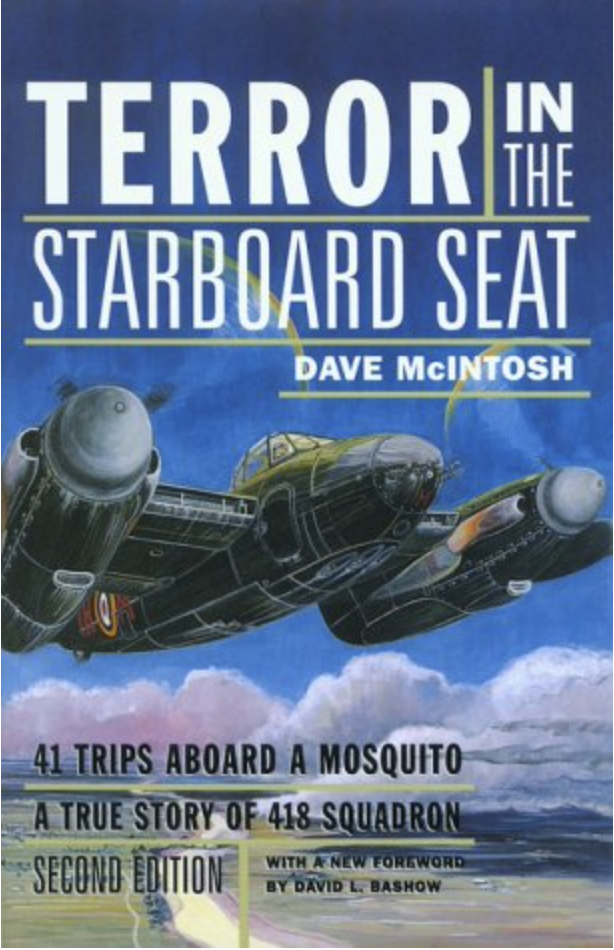
I am definitely starting to sound like a broken record now: the editing work has not allowed me to get any review writing done recently. Anyway, as ever, I have had a guest review (or three) sitting around waiting to be published. Robert Brokenmouth, a regular ABR guest reviewer, sent this in over a year ago and it has taken me this long to remember to find a half-decent image to use as the cover. I have the later edition of Mosquito Intruder, retitled Terror in the Starboard Seat, and it is one of those books that I have always felt warm and fuzzy about at the prospect of eventually reading it. No pressure now to crank out a review now! Andy Wright

Now then. There aren’t that many books by the chaps in the Mossies who went into hostile territory at night to hunt Luftwaffe night fighters and the occasional target of opportunity. And there aren’t that many books on the aviation war in the Second World War that are actually funny, nor are there that many which focus on the fear felt by the aircrew; Mosquito Intruder ticks all three boxes and for that reason deserves a place on your shelf. And, if you’re one of those nutters who like to have at least one book by a veteran of every squadron possible, McIntosh was with No. 418 Squadron, so that will keep you happy as well.

Not sure what the reason for this is. Certainly Mossie night ops were regarded as ‘safer’ than night bombing by the ground staff, but get in your wayback machine and tell that to the young Dave McIntosh and you’ll get a disbelieving look.

See, young Dave is utterly bloody petrified most of the time and, to read him you’d think he was a mostly incompetent navigator. He (and his pilot) manage to arrive home safely (41 ops) and play this for laughs in the mess to their colleagues. The contrast couldn’t be more stark; while we, as parties interested in wartime aviation, are accustomed to reading hair-raising stories told with aplomb after the years have allowed fear to be stifled or forgotten (at least for an audience), McIntosh’s method offers a critical insight into the reality of that war.

I won’t speculate on the reasons for McIntosh’s obvious ongoing terror (particularly given the relative safety of the Mossie), but I will say that flying accidents while training would not have helped (especially one which could, simply, have happened to anyone). There’s also one particularly ghastly story which I won’t repeat, but it absolutely hammered me when I read it. 

Also amusing is his description of him preferring women to have a large bust because otherwise they’re not worth bothering with; as we continue it becomes apparent that McIntosh is reflecting on his younger, more callow self from a distance of several decades.

That said, despite being an engaging and informative read, I also found it a bit lopsided, as if certain parts of the book were written at different times in the author’s life, or as if some parts were written, then edited before writing the rest. Speculation, of course; the lopsidedness comes from the combination of a rather flip way of expressing things as well as describing things more seriously.

But this is to carp, and anyway, I only have one actual moan and it’s to do with the publisher, not the book; in my copy, pages 62–63, 66–67, 70–71 and 74–75 are all blank – not good odds over 184 pages. 

But such flaws in the publishing world are rare; Mosquito Intruder, or the later, probably better-known, edition Terror in the Starboard Seat, is a must have. 

ISBN 978-0-71953-9-183 or 978-0-77373-0-892

21 July 2022

Bristol Beaufighter - John F. Hamlin


There I was sitting at my local cafe, kids-back-at-school celebratory coffee and book session delayed by one day, when I get a phone call from the post office to say I had a parcel that had somehow missed the day's delivery. A short walk and 4.5 kg of Air-Britain magic was in my hands. Flintham's Truculent Tribes bargain and the 2022 Propliner were incidental to the real reason for the order: John Hamlin's Bristol Beaufighter made up most of the weight, 420+ pages of glossy A4 hardback goodness to be exact.


It is a beautiful book and is loaded with superb photos, all magnificently reproduced on quality paper and leaving few aspects, if any, of the aircraft to the imagination. There is a surprising amount of colour too, from ‘sidebars’ to period advertisements and a great number of clean profiles that feature some of the rarer markings seen on Beaufighters.


I am not an Air-Britain aficionado or member. While I love all aviation to varying degrees, my focus is fairly obvious, so I’ve never been able to justify membership of an organisation with a much broader (and understandable) remit. The few A-B books I’ve seen – Hamlin’s earlier Flat Out, the history of No. 30 Squadron, for example, was bought secondhand – are unsurpassed on the quality front, but I’ve never been one for lists of serial numbers, as useful as they are for regular referencing. The 240 pages of Beaufighter serials, a la Morgan and Shacklady’s Spitfire: The History (but on far superior paper stock!), are the raison d'ĂȘtre of this book and clearly the product of years of work. That’s a big chunk of an expensive book. What’s left is roughly 20 pages of the type’s development, including a column and a half on the Australian production line, ten pages of an ‘Operational overview’ and then a comprehensive 100 pages of potted histories of the units (squadrons, wings, OTUs, etc.) and air forces that flew the Beaufighter, which is effectively a longer ‘operational overview’. The appendices are also of interest, but everything outside of the serials section is all too brief. 


The unit listing is impressive and there’s some fascinating inclusions, although the South Africans deserved more than two pages, despite only having the two units. Happily, the Royal Australian Air Force – squadrons and support units – gets a decent ten pages, the USAAF five and everyone else (France, Turkey, Portugal, Israel and the Dominican Republic) seven. However, again, it’s all in overview territory. There’s little more than the occasional one-liner quote from aircrew, but that’s perhaps a rabbit hole the author didn’t want to/couldn't go down. 


Speaking of the personal connection, there is a sobering tribute in the later pages dedicated to those who became casualties while serving with a Beaufighter unit (killed, wounded/injured, prisoners, etc.). Three columns per A4 page for 20 pages. It is a lovely inclusion. Imagine, though, the power of including the words of some of those listed or their contemporaries – giving them a voice. It would have made for a much longer book, of course, or a mighty second volume, but perhaps this is one of the few paths A-B rarely treads (if at all).


The Beaufighter’s full story continues to this day with long-term restorations to flight underway and great work being done on Hercules engineering in Queensland, Australia. Coupled with recent wreck discoveries, and even the important recovery of crew remains over the years, it is clear the type’s history did not end when the last airframe left military service. Again, the inclusion of such material was probably beyond the parameters the author was required to work within but would have highlighted the present stature of the Beaufighter in today’s historic aviation community and its exciting future. Extend that to a survey of the few surviving examples and the story is (more) complete. All this present-day material is, granted, nice to have.


It's a Beaufighter book and that's why I now own a copy and, if you're a fan, you should too. It is good, but it is not the comprehensive treatment expected. I wanted more, what it says on the tin, ‘The Full Story’. It is an expensive book and will be a standard reference, though the cost needs to be weighed with what the reader is after. It's more than just a serial number listing, and there are some gems throughout, but if you're after an in-depth narrative on the type, how it influenced strike operations, what it was like to live with and fly, this is not the book for you. Indeed, there's still not one book that can do that (but have a look for Neville Parnell's Beaufighters over the Pacific, Graeme Gibson's forthcoming Road to Glory, Athol Sutherland Brown's Silently into the Midst of Things, and anything relevant by the great Roy Conyers Nesbit, to name a few). It is, however, certainly the most significant overall Beaufighter title since Chaz Bowyers’s 1970s/80s works.


ISBN 978-0-95130-5-127

12 April 2022

Boys, Bombs and Brussels Sprouts - J. Douglas Harvey


More than three months into 2022 and all I've done is add several covers of new books as they've crossed my desk. As before, the manuscript editing work is keeping me busy (follow Wright Stuff Editing & Proofreading if you want to get an idea of what I'm up to) and away from review writing, even reading. For the lack of content on here, I apologise. I must also proffer humblest apologies to Robert Brokenmouth, guest reviewer, for holding on to this and two other reviews since July. It doesn't feel like that long, but the emails say otherwise. Here, then, from a writer who knows how to get inside the head of a Bomber Command author, is a review of a book that some have said is quite hilarious (in a good way). That's not something you come across too often with BC, but there you have it. It's also a book I simply have not been able to find a nice copy of for a decent price. When I do, the postage is silly. Anyway, that's too many of my woes. Enjoy. Andy Wright.


We all have our favourite aviation books. You might think mine can be guessed at: Cheshire, Gibson, Charlwood, Cusack, Ollis.


Well, those five, yes. But there are several others; Yates (see here) is one, and this little cracker is another.


While some of us buy a military autobiography because we have an interest in the historical events, the small boy inside us (certainly me, I’m afraid) wants nothing but incredible adventures. Mel Rolfe’s series of books were hugely popular for that reason. Sprouts is brimming with events and details I have never read before in an aviation biography (never mind one on Bomber Command). Harvey’s knack of recall of specific things brings into sharp focus the grimmer everyday aspects of RAF life – told in such a way that sharp cackles of laughter on the bus are so frequent that you’ll get looks from disapproving teenagers. I won’t spoil it – though I’d love to – but Harvey tells his story with frankness, comic contempt, and an astonishing tenderness. It’s a hugely powerful book and, if you've not read it, you are in for a treat.


Harvey, a Canadian, joined No. 408 Squadron, Bomber Command, in June 1943 and survived to be screened in April 1944. Like Cusack and Ollis, he has little respect for the RAF system of promotion (arguing with the CO about the fact that officers get more pay than sergeants and all essentially do the same job; again, I won't spoil it). Unlike those two, however, he can recount a fantastic and very rare appearance by Bomber Harris.  


Lastly, if there’s a sorely overlooked book of the bombing war just waiting to be written, it's about the fussy, impractical, bullet-proof officer who wangles a posting to ops and proceeds to stuff everything up with a sort of self-justified glee. Cusack and Ollis each encountered one of these ding-bats (to the point where one surmises that a principal reason for writing about their experiences in the first place is to reveal and humiliate the ding-bat). Yates was one of these training characters, but he at least comprehended that he was far from invincible and endeavoured to bring back his crew (and himself) alive. Harvey encounters not one but two (leading me to think there should definitely be more known about these characters); and, not wishing to spoil the surprise, I’ll leave it there.


Let your fingers do the walking, as they say, and fish out the credit card. This is a somewhat under-appreciated (I won’t say ‘forgotten’) work that should be a perennial like the works of the ‘famous five/six’ mentioned above.

ISBN 978-0-77104-0-481

28 May 2021

Sailor Malan - Philip Kaplan


Humblest apologies, everyone. I've been incredibly busy with editing work that I haven't had a chance to get any review writing done (let alone reading!). It is great to be busy but I have been missing my, as of this year, new 'Mondays are for review writing' sessions. Anyway, here's a new guest reviewer for ABR. Andrew Kitney works for an airline in the UK. He gets around a fair bit as a result, more so eighteen months ago (!), and is a regular airshow attendee. With a passion for just about everything in aviation, he's more often seen over on Flight Line Book Review. This is the first ABR-relevant title I've managed to get in front of him. It's a bit odd seeing the same publisher release two books on Malan from two different authors so close to each other, but there hasn't been much focussed work on the chap of late so no major complaints on that front. Enjoy! Andy Wright.

Anybody with more than a passing interest in the Battle of Britain will have heard of the South African RAF Ace, ‘Sailor’ Malan. He led a fascinating and varied life, so I was looking forward to this book

With a somewhat different than normal path to the RAF, his early days on the family farm in South Africa are well conveyed. As a young boy he became a fantastic marksman, something that would stand him in good stead throughout his flying career. 

Detailing his early career as a sailor, which is where his nickname originated, starting on a South African training ship and then into the merchant fleet, he experienced European and Atlantic ports. The city of New York and ports in Germany both had a significant influence on him. His spent a short spell training in the RN and, with war on the horizon, his application for the RAF and subsequent flight training is nicely covered.

The scene is set with a fulsome account from his friend, and fellow Battle of Britain pilot, New Zealander Al Deere, covering their relationship from the early to latter parts of Malan’s RAF career. A subsequent chapter on the Spitfire moves onto Malan’s time at Hornchurch and some of the early sorties flown during the war and in the Battle of Britain. 

Describing nicely what Malan is renowned for, a chapter talks about the changes he introduced to combat formations and fighting, together with his ‘10 Commandments’, the golden rules, of air combat. These tactics contributed significantly to his success. 

The frantic days at RAF Biggin Hill at the height of the Battle of Britain are well described, including the frenetic sorties and what it was like living on the base at the time. His tenure as base commander several years into the war is also covered. Accompanying combat reports spotlight the relentlessness of combat. 

With a nod to the inclusion of a like-minded character in the famous Battle of Britain movie, a later chapter covers reflections and plaudits from a number of pilots and commanders of the period as well as historians. 

The book finishes with how Malan has been remembered after his death. This follows a chapter looking at his post-war life in the political turmoil of his native South Africa. The narrative is accompanied by a few black and white photos of Malan and his compatriots to add to the scene setting. 

To call this a complete and comprehensive biography of Sailor Malan would be erroneous, especially with numerous pages of his wartime life being devoted to such key compatriots as Al Deere. They do, however, provide the context for the period in which Malan served and add to the overall atmosphere of the time and place of his service. Overall, I enjoyed this book and it took me back to my younger days where I searched high and low during my weekly library visits for similar accounts of Second World War heroes. 

ISBN 978-1-52678-2-274

01 January 2018

Lancaster Bale Out - Clive Smith


I get a bit twitchy when I see a new Bomber Command book written by a relative of an airman. That’s a bit jaded so don't mind me. My ultimate desire when reading is to bury myself in a memoir. A book written by a relative could never be regarded as a memoir. Or could it? Lancaster Bale Out is a quality Bomber Command book written by the second cousin of a 106 Squadron RAF WOp/AG. It is not really, however, a gunner's story. It is largely the wartime tale of his bomb aimer, the sole survivor of the crew. More than anything, it is his memoir.

The author’s second cousin, Jack Hougham, trained in the UK and was ready for OTU by late 1942. Fred Smooker, the bomb aimer, was from County Durham and a coal miner like his father. Interestingly, a number of the eventual Lanc crew had been miners or were from a mining family. Perhaps a sixth sense for that sort of thing contributed to bringing them together. Anyway, Fred began training as an observer proper in Canada. Clever and astute, he unfortunately suffered from terrible homesickness and gave up during his course to the point that he failed. He was re-mustered on the first bomb aimer course in Canada, returned to the UK and had joined a crew of five at OTU by the end of October 1942. His pilot was an American, a relatively rare thing in Bomber Command, and a chap who proved to have his head screwed on straight when it came to flying ops.

Before long they picked up another gunner and a flight engineer and converted to the Lancaster before joining 106 Squadron at Syerston. Their first operational trip as a crew was to Lorient in France on the night of 2/3 March 1943, but the intercom failed and they wisely returned home. Their first completed op was to Essen three nights later. They flew their fifth completed op at the end of April. Rosner, the American pilot, was one of those skippers who liked to keep weaving and rarely flew straight and level when not on the bomb run. He would also ‘go downhill’ on the way home so the Lanc picked up a bit of extra speed. His actions were indicative of an impressive, competent crew who got through a few scrapes during their tour.

Sadly, all the skill and attentiveness can never make up for a bomber crew’s luck running out, be it on their first op or their thirtieth. On the way home on three engines after their 20th op, a raid on Cologne on 8/9 July, they were shot down by a German fighter. The rear gunner managed to bail out, but was killed. Fred Smooker, the bomb aimer, was the only man to survive. He managed, through the help of a dizzying array of brave French men and women, to spend the best part of three months evading capture and was on the way to Spain by train when the authorities caught up with him. Amazingly, he then spent 56 days in solitary confinement in a Parisian prison before arriving at Stalag IVB in early December 1943. There he remained for the duration. He returned home with a desire to pick up where he left off and finished his mining studies to become a mining engineer. He took his young family to India for six years in 1951 to work on the railways and eventually retired in the early seventies for health reasons. While working in coal pits could never be referred to as good for anyone’s health, Fred’s experiences in France and Germany – the injuries, rough treatment and general malnutrition – must have also played a part. He died in 2008, some thirteen years after replying to the author’s initial contact.

This book has two main strengths. Firstly, the majority of the narrative was put together by Fred Smooker. He had written about parts of his wartime career over the years. Indeed, the author discovered he was still alive when he read one of these accounts. Once Fred and Clive got together, however, Fred committed to writing a full account of his war from start to finish. This is what LBO is all about and why it is really a memoir. The style is quite conversational and Fred is surprisingly honest about his fears and trepidation throughout his adventures, be they training in Canada or on the run in France. He is not afraid to expose his failings despite his upbringing in a stable household and ability to work in harsh conditions. His time underground built a natural strength, physically and mentally, that was tested time and again after he was shot down. It takes a special person to continually go deep into the earth to follow a relatively narrow coal seam and this determination played a large part in getting him through.

The second main strength of LBO is the author’s beautifully light touch. He recognises the value of what Fred provided him with in instalments over the years. Footnotes are many and detailed and the appendices include copies of official documents and list the crews, and the details of their losses, that some of the men Fred encountered were a part of. There are several sections in the narrative where it is clear the author has added some context or additional detail, but I am certain there are a few more I didn’t pick up on such is the seamless way they have been stitched into Fred’s words. There is very little discussion of bomber tactics, or the development and evolution of same, so the narrative remains focused on the crew and, of course, Fred. His writing is supported by a large number of letters written by his Canadian mid-upper gunner and the author inserts passages written by contemporaries, most notably the author of Lancaster to Berlin, Canadian Walter Thompson DFC*. That said, the training and operational side of things last for just over 100 pages, in a 300-plus page book, with Fred’s evasion and incarceration taking up the majority of what's left. His account of his time as a POW paints quite a bleak picture, but he slowly rebuilds his confidence and general health to the point where he begins to work on escaping. There is little mention of escape committees and the like. If anything, the theme is one of survival rather than continuing on with tales of derring-do. It doesn’t stand out in the myriad POW accounts, but it is well written and pulls few punches despite Fred having had the benefit of several decades to reflect.

You know how you shouldn’t judge a book by its cover? Well, to some extent, and perhaps necessarily, I still do, so you can imagine what I first thought of LBO. Horrendous. The book has sold well, however, so a possible second edition should see a much more attractive and accurate design. This one was a product of the publisher and, considering how well Tucann did with the rest of the book, it’s a bit of a let down if you look for accuracy in a cover as an indication of an aircrew book’s content.

Lancaster Bale Out is a true page-turner. It suffers from very few niggles – some weird comma use and the mention of the US not being at war in 1942 were about it – that are almost completely hidden by a narrative that will hold any reader in rapt fascination. This book will not last long as a purely self-published (more or less) effort. A specialist publisher is bound to pick it up and run with it and it is exciting to think of Fred’s story, and the author’s fine work with the narrative, being presented in a second edition. Either way, this is one recent Bomber Command book that should be on your shelf. It is a solid, well-illustrated paperback that you will struggle to put down. While the author, when he set out to satisfy his enduring fascination with his second cousin’s wartime service, did not intend to tell Fred Smooker’s story, it is the outcome of one of those coincidences so often encountered when researching Bomber Command. A truly impressive package.

ISBN 978-1-907516-26-9


05 November 2017

High in the Sunlit Silence - Commander Tony Vine RANR


A formation of Cessna Cranes on the cover of a book about the members of a RAAF training course is not something you expect to see. Surely an Australian book should feature Ansons or Oxfords if it’s going to showcase twin-engine trainers. It does, however, suggest the journey of many Commonwealth airmen as the vast majority, drawn from almost all points on the compass, converged on the war in Europe. While Tony Vine’s first book, High in the Sunlit Silence, focuses on just the one course, the men’s stories are, like the cover, representative of those who undertook earlier or later courses in Australia, or those who did the same in New Zealand, Canada, Rhodesia and South Africa. Representative, yes, but all unique. As I often say with a book about a bomber crew, “here’s another x aircrew that have had their stories told at last”, and that is very much the case here. To tackle the lives of fifty men, however, takes some doing.

The trainee members of an elementary flying training course share a bond equivalent to those shared with the squadron mates most eventually served with. To trace the various service paths of each trainee is relatively straightforward. After all, that’s what archives are for, albeit full of abbreviations, acronyms and jargon that are just screaming to be fleshed out. That’s where the challenge lies. Successfully telling the stories needs more than service records. It needs family members and friends, diaries and letters. Even then the rich vein of information deposited by one man, and keenly followed by the researcher, simply does not exist with another. Some were prolific writers, for better or for worse, while others may not have had the chance to do so and left little behind. Multiply that mix of endless hope, occasional despair, and enduring fascination by a factor of fifty and you can understand what the author has gone through to trace the men who made up Pilots’ Course 20 at No. 5 Elementary Flying Training School, RAAF Narromine.

The timing of the beginning of the course, December 1941, is significant, as another ‘front’ requiring men and machines opened as the training progressed. The vast majority of the men who became aircrew ultimately served in Europe, however, and they arrived, for the most part, in the second half of 1943 and many ended up in Bomber Command (a surprising number joined Coastal Command or flew medium bombers with 2 TAF). That time of the bombing campaign was not a good one for the RAF. The Battle of Berlin was soon to get underway and losses were already incredible. That’s why so many of the men who were part of Course 20 ended up in the UK. They went where they were needed the most.

The genesis for this project was the author researching his uncle. Bill Gunning was killed at the controls of a Wellington in 1943. He had trained with some of his course mates in Canada (hence the Cranes on the cover) and kept in touch with others so his influence is fairly consistent through many of the biographies.

Eighteen of those on the RAAF Narromine course were killed in accidents or in combat. Several did not become pilots in the end, instead re-mustering in another aircrew role, while a couple did not make the grade at all, but continued to provide good service. Eighteen out of fifty, relatively and a little indelicately speaking, is not the worst attrition rate considering some of the earlier courses were all but wiped out, and there are memoirs, like Hugh Garlick’s excellent One Life Left or ‘Bush’ Cotton’s marvellous Hurricanes Over Burma, that provide sobering evidence of this. How many times have we seen photos of ranks of men lined up in front of an aircraft with some, many even, having a little cross drawn in pen over their heads?

The great thing, of course, is that most of the men featured survived the war. Unsurprisingly, a decent proportion lived fractured lives in peacetime. We call it post-traumatic stress disorder today, but back then, while it wouldn’t have gone unnoticed by those close to the subject, it just wasn’t dealt with.

High in the Sunlit Silence is a page-turner, but its 330 pages are best read in short sittings. That’s a weird thing to say as everyone wants a book that is hard to put down, something you can lose yourself in. However, each biography is presented as a standalone chapter. Each chapter has effectively been written for the family of the man featured. There is, therefore, a lot of necessary repetition from chapter to chapter, especially for those men who travelled the same path to war (Narromine, Pacific crossing, Canada, Atlantic crossing, UK). While the author has done a fine job to tweak each biography to make them all read differently, there’s only so much you can do with the same information and the first few paragraphs, pages even, rapidly become familiar territory. If the reader is not careful, they will find themselves succumbing to the temptation to skim these parts and, frankly, not giving each man the respect he deserves with a good, thorough read. I caught myself doing that a couple of times before I changed my reading sessions from “I need to cross another book off the list”. I recommend tackling five chapters in each sitting. There is less chance of the stories blending into each other. Take your time.

There’s also a feeling of dread that permeates the book as the reader progresses through it. This is partly caused by the anticipation of wanting the subject to survive, but is largely due to the footnotes. When other personnel are mentioned, the author helpfully includes a footnote listing basic biographical detail. When a crew is listed, and there are dates of death after many of them, you know what’s coming. As mentioned above, less than half of the men from the initial course were lost, but it feels like a lot more.

A solid paperback, the book is not heavy with photographs, but it does provide a good selection beyond the headshots (from various sources) that kick off each chapter. The writing is to the point and the author does not embellish where the information available is lacking. Rather, he ensures as well-rounded and as careful a biography as he can before moving on to the next one.

There’s the occasional missing word in the text, but nothing out of the ordinary or of a material nature. It would be good, however, to see some of the aircraft names tidied up. ‘Montrose Master’, ‘Oxford Anson’ and ‘Hampton bomber’ escaped the proof-readers and, while perhaps worthy of a wry grin when encountered, are details that might mislead, especially when the chapters are written so families can use them in memorial services or other relevant events or displays.

So many of the men featured in High in the Sunlit Silence would be barely known outside of their families. The author has done remarkably well when, in several cases, he hasn’t had a lot to go on. Each subject is given equal attention, and obvious research effort, lack of material notwithstanding. It’s a bit of a dark horse in the way the practical writing style lays out the story in a straight-forward manner, but allows the circumstances of each tale to dictate the reader’s connection and emotional response. There’s a depth to this book that is not immediately evident. It is all the more valuable for its very existence.

ISBN 978-1-925590-21-0