24 May 2015

The RAAF Hudson Story Book Two - David Vincent


I would like to introduce you to a friend. This friend has been my constant companion for the past three-plus years. As you’d expect, this friend is reliable and can pick me up when I am a bit lost or trying to escape. Always there with the answers and a source of inspiration when I want to know how things should be done. May I present The RAAF Hudson Story Book Two by David Vincent.

This book has been, until recently when a second pair of little hands became very mobile, on my bedside table since it arrived in the mail. We were living a mere seventy kilometres from the world’s only flying Hudson when this book entered my life and, quite frankly, I was, and remain, rather enamored by this aircraft. From some angles on the ground it is a somewhat portly machine, with a deep fuselage born of an increased internal capacity inherited from its civilian predecessor, the Lockheed 14 Super Electra, yet it is all style and there is more than a hint of its art deco predecessors. In the air … it is a somewhat portly machine but it just flows. Even the lumps and bumps that only the military can bring to an aircraft design cannot hide the curves. The wings taper to a point that seemed impossible thirty feet closer to the fuselage. Thank goodness for straight leading edges. The tail is something that could only come from Lockheed. Watching a wingover well past ninety degrees just adds to this aircraft’s appeal.

The Hudson was a machine that was there at the start. Like the Blenheim, it wasn’t the best thing for the job but, in reality, who could have envisaged just what it would have to do before it was needed to be done? The Hudson was there and it did what was asked of it until something better, designed or improved from the lessons learned, came along. Even then, when the Bostons and Mitchells and Beaufighters were on hand to take over, the Hudson soldiered on. It flew sorties against the Germans bearing down on Dunkirk, it hunted U-boats and snooped around Norway for enemy shipping. In Australia, where it was the RAAF’s only modern bomber at the start of the war, it patrolled shipping lanes and was in action against the Japanese in Malaya before Pearl Harbor was attacked. For quite some time it was the RAAF’s sole means of hitting Japanese targets with any semblance of strike power. It was inadequate against Japanese fighters (what early Allied aircraft wasn’t?) but its crews had a stout ship at their command and they, in turn, were stout of heart.

The book. Yes, the book. The whole reason for waxing lyrical above. I have said, several times in the past, that I use the book in hand as a benchmark. Well, The RAAF Hudson Story Book Two is what I use to measure everything against. It made me go out and buy Book One not because I could afford it (or, more correctly, had remembered I hadn’t bought it yet) but because it didn’t seem right not to. Lightning (snigger) can hit twice as it turns out but Book Two is a further refinement. Obviously, it is not the full story.  The rest, of course, is in Book One. Book Two is 420+ pages of RAAF Hudson operations in Australia and areas to the north-west and north-east (i.e. New Guinea etc). These were the final operational areas needing to be covered after Book One so Book Two then continues with the Hudson’s work as an air ambulance and transport (ideal work given its airliner roots) before concluding with its extensive post-war career. If a Hudson did it and it’s relevant to this book, it is in this book. I have spent hours, when not reading ‘properly’, just leafing through and stopping at whatever caught my eye. Often, it was just an interesting photo, easily the most arresting thing on a page, and an awe-inspiring caption. I can count on one hand, maybe two, the number of captions that have less than 35 words. Many have more than 150. That’s the sort of detail this book provides. I’m shaking my head now, and grinning wickedly, at the thought of it.

David Vincent’s pedigree is without question. The man who brought us Mosquito Monograph and Catalina Chronicle – both still sought after books – took more than ten years to bring Book Two into the world. It’s pages packed with text, two columns per page, hundreds of photos, reams of endnotes, and a narrative that is as much analytical as it is informative, combine to create a robust and all-encompassing history that I know will never see its equal. Should there be more written about the Hudson? Of course there should be. Will anything new come to light? Most definitely but whoever finds it will have the Vincent Hudson books within easy reach and will have smiled every time they caught their eye. These books aren’t life-changing, they are life-fulfilling. They are big, they need to be, and they are heavy, and they may even crush you if you read them lying down in bed (I know these things!), but they need to be. To leave these books wanting more is just not going to happen. They need to be bending your shelves now if they’re not already. Nowhere will you find a type history more readable or satisfying. And, well, it’s RAAF Hudsons. Enough said.

ISBN 978-0-9596052-3-5

13 May 2015

'Artie' Bomber Command Legend - Vincent A. Ashworth


Arthur Ashworth is one of the relatively few who took the time to record their wartime memories. He is hardly a household name. His awards – DSO, DFC*, AFC*, MID – suggest he should be better known. However, while his long RAF career would be relatively easy to recount, a good biography needs the bookends – pre-war and post-RAF. Not many have much of either and are the poorer for it. Such things are sometimes best left to those who knew the man. In the case of Ashworth, his younger brother does the honours. ‘Artie’ Bomber Command Legend is the result and, yes, there is a bit of hero worship but it is kept in check. However, when you’re dealing with ‘Artie’, it really can’t be helped. Here is a man who, frankly, lived up to the legend.

‘Artie’ was the seventh of the Ashworth children. His father was well regarded in the New Zealand agricultural industry. Such was this regard that, in 1926, he was accepted to manage an experimental sheep station in the Falkland Islands. The entire family followed him over before returning home in 1928. Ashworth Senior died in 1932 and the strength and determination exhibited by ‘Artie’ during the war was in no small part due to his mother who shouldered the responsibility of raising her large brood during the Great Depression.

With his brother and best friend, Corran, ‘Artie’ more or less excelled at everything he did as a teenager. He was fondly remembered by his peers (of whom many were interviewed) and the family in general, despite their financial struggles, were fine members of the community. The war would take anyone no matter their background. ‘Artie’ and his brother Archie would survive. Corran would not.

Flying training for our hero began in late 1939. Training initially on Tiger Moths, ‘Artie’ moved on to Vickers Vildebeests and Fairey Gordons before embarking for the UK to do his time on OTUs prior to joining No. 75 (NZ) Squadron. Eight months later, at the end of August 1941, his first tour was complete after 31 ops. Not wanting to work as an instructor, ‘Artie’ volunteered for service in the Mediterranean and, with a new, all-volunteer crew, flew a Wellington to Malta. In a little more than two months he flew more than 20 ops, from Malta and Egypt, against targets in Italy and North Africa. Certainly quite a change from operating out of an English airfield! An even greater change came when ‘Artie’ was posted to No. 216 Squadron at El Khanka in the Nile delta. Here he flew Bristol Bombays and four engine DH86s to deliver supplies to the front line. The return journey was, more often than not, a more sombre affair with wounded soldiers and aircrew filling the aircraft and heading to the rear for treatment. The flights were classed as operational but it was hardly the best employment for an experienced and effective bomber pilot. His most ‘shaky do’ was to come, however, when he returned to the UK.

‘Artie’ was back with his countrymen on 75 Squadron by mid-1942. By the time he left the squadron again, in August, he had completed 64 operations, been awarded the DSO and developed a reputation for getting the job done. His upbringing of accepting responsibility and excelling at the task at hand was the force that drove him forward. He was the perfect bomber pilot and, at 22, had completed his third tour.

This determination was tested to the hilt when, after a month as a founder member of Don Bennett’s Path Finder Force HQ staff, Ashworth wangled an op to Saarbrücken and flew with an unfamiliar crew. A flare ignited in the bomb bay and set the rear of the Wellington on fire. ‘Artie’ instructed the crew to bail out but found his parachute missing. He made it home alone after side-slipping to put the fire out. He was lauded by the media but, curiously, not by the RAF. He was a valuable member of the PFF HQ that was developing the tactics that would ultimately transform Bomber Command into a force that resembled the early efforts of Ashworth and co in name only. Perhaps this is why the op was frowned upon. Either way, he was soon on a ship home where he was given a hero’s welcome upon arrival in mid-1943.

He was very much a changed man. The modesty was still there but he now had that work hard, play harder, live for the day mentality that those who faced death daily naturally developed. His family adapted, he was still ‘Artie’ behind the chest full of medals after all, but the RNZAF weren’t too sure what to do with someone so over-qualified. Ultimately, he attended staff college and served at some of the RNZAF’s major bases in the Pacific. He was back in New Zealand and training to be a fighter pilot by April 1944 and was flying operationally again by August. This time, however, he was flying Corsairs with No. 17F Squadron on Guadalcanal. He was, by all accounts, not the greatest of fighter pilots but was certainly universally respected. While he was kept busy, ‘Artie’ became desperate to return to the bomber war he felt he was missing out on. With hindsight, given the losses Bomber Command experienced in 1944, perhaps this sojourn in the South Pacific saved his life. That’s not to say flying Corsairs was without risk. It’s just that the chances of survival were considerably higher than attacking Occupied Europe time and time again.

He managed to fly a further thirteen trips with No. 635 Pathfinder Squadron before his war ended. This took his total to 78 bomber operations. His next flights were for Operation Manna, repatriating former POWs and taking ground personnel on tours of a devastated Europe.

‘Artie’ made a career of the RAF and did not retire until 1967. He served as an instructor in the Middle East and commanded a Communications Flight there. A stint as a test pilot at Farnborough followed before he was posted to command No. 139 (Jamaica) Squadron and then No. 59 Squadron (both flying Canberras). ‘Artie’ settled in England and became a hotelier and then ran a small block of holiday units. He remained an unassuming chap with the only public indication of his achievements being the medals he wore when collecting for the British Legion. He died in 1994.

This book, from Fighting High, is the UK edition of the author’s self-published paperback. While the original is a nice and heavy softcover, it pales in significance alongside the new hardback. Like the man, it has an understated presence and the designers have cleverly used Ashworth’s most noticeable feature – his epic moustache – almost as a logo as a rendition of it appears in the front papers and it is the only mark on an otherwise blank back cover. Little quirks like this reflect the care that has been put into the production of the book. There are many pages of Ashworth’s logbook reproduced on both glossy and ‘normal’ paper stock. This is an important addition as the logbook entries were written in copperplate and are beautiful to look at. A lot is added to the book by their inclusion.

While ‘Artie’ did write a short manuscript detailing his life, and this is referred to throughout, he was, as a man who did not blow his own trumpet, quite brief in some of the descriptions of his more harrowing or outstanding achievements. The author, therefore, has had to add depth to what he can by including the memories of those who flew with his brother. Remarkably, two of his colleagues from initial training, Rex Daniell and Bob Spurdle, wrote books of their own and, despite their differing careers, provide wonderful detail as they crossed paths with ‘Artie’ during the war. Where the details of what ‘Artie’ got up to are not enough, the author does a fine job providing a picture of what happened through contemporary reports and recollections.

It is here, however, that things can get a bit disjointed. ‘Artie’ was remarkable. No question there. The author’s writing presents him well and allows the reader to understand the man and, easily, like him. Even where ‘Artie’ remembers things incorrectly, and the author’s subsequent research proves otherwise, Vince gently corrects him. It is this affection and respect in the writing that gives this book such a warm glow. The research, however, more often than not, includes the experiences of others (as mentioned above). Once the passage is complete a mini-biography of the colleague in question often interrupts the narrative in bold text. As fascinating and as useful as these are, I found myself investing in another person’s war, going off on a tangent, when I was itching to get further along Ashworth’s experience. These biographies, and the chapter detailing the fate of each man on that initial training course in New Zealand, could easily have been included as appendices and not affected the quality of the book as a whole. This is a carry over from the first edition. That, frankly, was a bit all over the place and while Fighting High has clearly done a lot of work to tidy the manuscript, I think more could have been done to ensure the focus rarely shifted from progressing Ashworth’s tale. That said, sometimes it felt as though the author was keeping me in suspense as to what his brother would get up to next.

That this is the manuscript from an earlier edition is sometimes evident with a reference in the text to a photo that doesn’t appear until much later and good, flowing descriptions of, for example, the Wellington, weirdly interrupted by a couple of paragraphs regarding something else before returning to the original subject. As I mentioned above, a lot of work was done by Fighting High to tighten up what was in the self-published edition. A few things still got through though. Several names are misspelt, the Tiger Moth is referred to as the DH86 and I was befuddled by the Italian fighter designation “CD425”, amused by the “Fleischer” Storch and, in the otherwise excellent note section, somewhat dismayed by the “torpedo-carrying” Gladiators.

These, of course, are single words in an otherwise high quality biography. They are mentioned for completeness and to honestly reflect the frustration felt when I read them. My typos above are, I suspect, too many to count so, really, who am I to talk?! Nothing is taken away from the very fact that this book expertly paints a picture of who ‘Artie’ Ashworth was. On top of that, the reader fully understands just what he faced. Chapters Six and Seven set the scene for what Artie is about to step in to. The latter chapter does a very good job at examining the quality of character exhibited by bomber aircrew. Even the interlude that is Chapter 16, where Vince details the careers and experiences of two rear gunners who flew several ops with ‘Artie’, is a powerful tribute to the loneliest, and most at risk, member of a bomber crew.

The title is no grandiose statement. It is a fact. Artie completed all but thirteen of his ops in Wellingtons. He did not have the power to fly higher or faster as he would have in the Lancasters of his final wartime posting. He pressed on and added to his tally without a lot of fanfare, not counting solo return flights, and, similarly, earned respect, admiration and honours simply in the course of carrying out his duties to the best of his ability. He just got on with the job at hand be it at the controls of a Wellington or Corsair or using his experience to help develop campaign-changing tactics. The book is the same. It is a typical product of Fighting High – superbly designed with care and intimate knowledge shown in its production. The cover is the epitome of this understanding in that it is mostly a subdued grey with just the information a prospective reader needs. It is modest but imposing. “DSO, DFC and Bar, AFC and Bar, MID”.

A proud brother has shared his hero with the world effectively but quietly. If ever there was a book that resembled its subject, it is ‘Artie’ Bomber Command Legend.

ISBN 9-780992-620752

30 April 2015

Australia's Few and the Battle of Britain - now on sale in the UK

I'm afraid there is no full review for this month as I've been flat out with a few other projects and helping put the latest issue of Flightpath magazine to bed. Anyway, long-time ABR supporter Kristen Alexander has some exciting news - her latest book, Australia's Few and the Battle of Britain - is now on sale in the UK. It is published by Pen & Sword. This publisher makes some good, solid hardbacks but will have to be at the top of their game to match the sublime quality that was the 2014 Australian-published edition. Either way, you are guaranteed an excellent read. This will be one of the, if not the, top books released to coincide with the 75th anniversary of the Battle of Britain. There should be a review in the next issue of The Aviation Historian but, in the meantime, feel free to read, or re-visit, the full review published on ABR late last year.

For those in the UK, please note there is still a 5.00 GBP discount on the retail price of the book. Get in quick as  it may not last too long. It is also available in Kindle and ePub formats. 

All I can say is "enjoy" … and don't forget that this is the fourth book from this author. Although I regard it as her coming of age as an aviation biographer, her previous works are very much worth hunting down.


31 March 2015

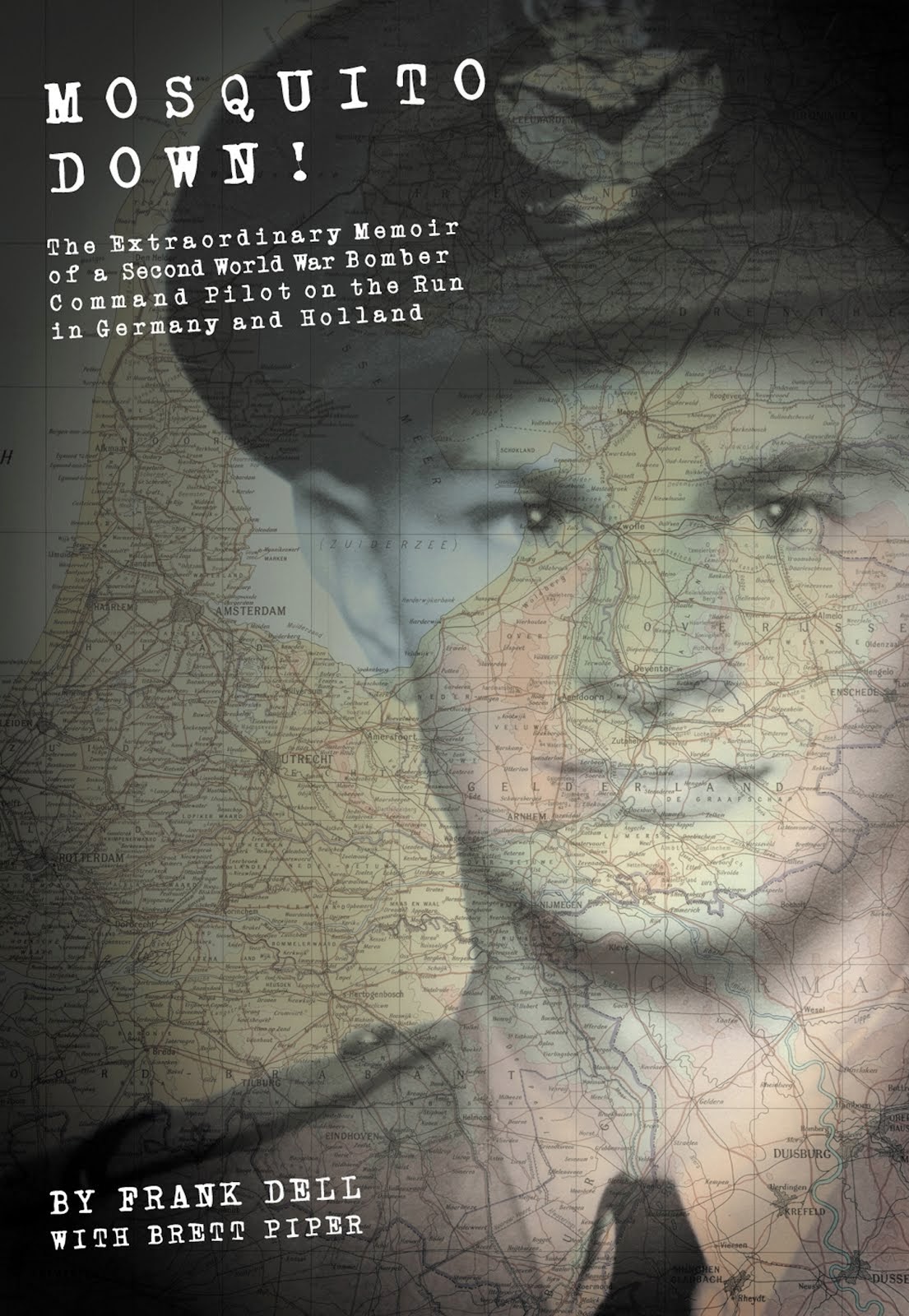
Mosquito Down! - Frank Dell with Brett Piper


There are a lot of Bomber Command books about at the moment.  I’ve said this before in previous reviews and ramblings.  Every second book in my reading and review schedule (“schedule” suggests order and discipline but there is very little of both!) is Bomber Command to the core.  This is great, and not before time, but I’ve discovered I can burn out on a seemingly never-ending diet of Lancasters, Halifaxes and Stirlings.  Sacrilege?  Perhaps.  Shooting myself in the foot?  Probably, but my passion ranges far and wide and, as many of you know, has a particular liking for the lesser known theatres and actions.  That said, put a Bomber Command book in my hand and I am happy.  Give it a twist and I am hooked.  Mosquito Down! did just that.

Frank Dell was the youngest of four children.  His father had served as a mechanic in the Royal Flying Corps during W.W.I after being deemed too old to fly.  He was badly injured by a spinning propeller but returned to the service as an engineering officer and was sent to Canada, and then to the US, with a team to set up training facilities for RFC pilots.  His son would follow in his footsteps to some extent.

The Depression had a significant and familiar bearing on the Dell family.  Two of Frank’s siblings were considerably older and had left home while the third was born with Down’s Syndrome.  Social propriety was a lot different to today and disabilities were very much regarded as an embarrassment more than anything else.  Both of Frank’s parents worked hard and the author provides a refreshingly open account of the extent of their love and care.  As the youngest he lived at home during the Depression period and was privy to the pressures his father prevailed against, to keep the family furniture business afloat, and the hard times other families experienced.  This understanding of the challenges faced by the average person led to Frank being a well-read and informed young man when Britain went to war.

He finished school at the end of 1940 and joined the RAF by way of a one-year university course that was advertised for those wanting a “long-term RAF career”.  Quite optimistic for that stage of the war!  Delayed by a stay in hospital at the end of his course, Frank was then sent to the US after soloing on Tiger Moths in less than 10 hours.

After being indoctrinated with the ways of the USAAF in Georgia, Frank completed his flying training at various airfields in Alabama.  He was selected to fly as an instructor so remained in the States until November 1943.  His thoughts on the USAAF ways of doing things, and Stateside life in general, make for interesting, albeit somewhat brief, reading.  Of particular interest is his mention of the infrastructure built across the US to enable airliners to navigate by radio beams.  He became very familiar with this system and the practice of ‘riding the range’.  It was experience that would stand in him in good stead when he finally flew on operations.

Frank had his mind set on flying Mosquitos.  With almost 1,000 flying hours under his belt he could choose what he wanted to do.  His experiences watching the Battle of Britain had him preferring a defensive role so, being a switched on and observant type who was aware of the loss rates among the bomber force, he volunteered for night fighters.  It was not until after the Normandy invasion, his training complete but no night fighter unit posting forthcoming, that Frank was interviewed by Hamish Mahaddie, selection officer for 8 Group Pathfinders, for a possible role flying PFF Mossies.  His beam riding skills notwithstanding, Mahaddie said he was ideal for the Light Night Striking Force and would have to complete 45 ops before being considered for the Pathfinders.  The LNSF Mossies, which carried 4,000-pound ‘Cookie’ blast bombs, were part of 8 Group anyway.  It was the chance Frank needed to fly Mosquitos and he didn’t need to be asked twice.

He took to the Mosquito well and fell in love with it easily.   Frank teamed up with his navigator, Ron Naiff, and was posted to No. 692 Squadron at the end of August 1944.  Ron had already completed a tour on Stirlings but the LNSF ops could not have been any more different.  Trips were flown at high altitude and were rarely more than four hours long, due to the speed of the Mossie, so by mid-October the Dell crew had already completed 12 ops.  They were shot down on number 13 … on Friday, October 13.

The target had been Berlin but they never made it.  Frank was ejected from the disintegrating aircraft but would not discover the fate of his friend Ron for quite some time.  Parachuting on to German soil, Dell struck out for Holland to the west.  After a week of sleeping rough, walking at night and an incredible number of close calls with German soldiers and civilians when, surely, the dark nights and bad weather hid his condition and identifying traits, he was discovered sleeping in a barn, in Aalten, Holland, a bare five miles from the German frontier.

What follows makes up the bulk of the book.  Frank is moved around several farming families and is integrated, after much vetting, into the local Resistance.  The author goes to great pains to describe, in his typical observant style, his Dutch friends and the conditions in which they lived during the occupation of their country.  The impact on his life, and the friendships he made, was perhaps greater than his time in the RAF.  It was six months of living on the edge, under the noses of a cruel and desperate regime, but among a hospitable and determined people.

Finally liberated shortly after the crossing of the Rhine, Frank, after the requisite leave, volunteered for transport work in India.  He returned after six months and, with no progress on an application for a permanent commission, left the RAF to join BEA in 1946.  He retired from British Airways in 1976 and remained active in the marvelous Escaping Society until it closed down in 1995.

The main focus of this book is, naturally, the author’s remarkable journey as an evader in Germany and Occupied Holland.  Do not expect great insight into the life of a Light Night Striking Force crew.  That said, the final op and a beautifully detailed account of the first operation are written about in depth (and are the only ops recounted).  The account of the first op covers every aspect of the entire process and, from what I can see, leaves next to nothing out.  This could easily have been a wordy list of “then I did this before doing that” but, such is the author’s ability to easily convey his experience, coupled with his observant nature, that the reader is completely absorbed from “ops on tonight” to crashing into bed post debrief.  It is business-like and matter of fact but cleverly written with the heart and mind of a lifelong flyer.

Speaking of fine chapters, and backtracking a little, Chapter Seven is a very good, concise discussion of the air war, and its technological developments by both sides, as it pertained to Bomber Command.  The author does not get bogged down in detail but manages, in a mere seven pages, to succinctly set the scene for his operational career.  It is necessarily short, and could have been so very much longer, but few could have done it better.

The author’s time with the Dutch Resistance is, however, what this book should be known for.  While he was not involved in blowing up bridges or other ‘Boy’s Own’ activities, thankfully, Frank was completely immersed in the day-to-day life of the local ‘cell’ and, once again coming back to his skill for observation and interpretation, the recording of this life is one of the more important and valuable accounts I have come across.  It is on par with David and Sydney Smith’s tale of The Comete Line in Lifting The Silence.  Happily, the book, through its photo sections, is able to give faces to the names of Frank’s many brave Dutch friends.  He kept in touch with some of them after the war and their post-war lives and fates, along with other ‘characters’ featured (like Ron Naiff), are given the space they deserve in one of the final chapters.  They were extraordinary men and women who melted away and, for most, simply became another face in the crowd.  Frank Dell has honoured their memory in no small way.

Dell wrote MD! “with Brett Piper”.  The latter’s influence is unknown but between them they have produced a book that sneaks up on you.  I was not expecting the expressive and open account of hiding in Holland.  The cover is understated but if you look carefully you will see the map is the area of Germany and Holland in which the author had his adventures.  The story is all there in his face and that map.  As expected, this is a well-designed and produced book although the angled text on the cover continues on the front and back flap and, in the confines of said columns, looks a bit odd.  It’s the first time I’ve had cause to stop and question a design aspect of a Fighting High book.

I cannot, however, and will not, fault the content.  Yes, this is Frank Dell’s wartime memoir but it could just as easily have been called “My Life with the Dutch Resistance” such is the breadth of his account and the honesty with which he tells it.  While not a huge book, at 169 pages of main body text, it punches above its weight and presents a much-needed tribute to the men and women of the Dutch Resistance.  Perhaps, like has happened with Bomber Command, more can be done to bring their service the wider acclaim it deserves.  Mosquito Down! has achieved this through the memories and respect of an old flyer who owes his life to them.

ISBN 978-0992620721