Showing posts with label mosquito. Show all posts

05 September 2023

Mosquito Intruder Pilot – Jeremy Walsh


The Far East. That’s how you get my attention. Right, the book is off the shelf. Read the back cover description and/or blurbs: ‘Intruder’, ‘night fighters’, ‘strain’, ‘twitch’, ‘Oscar’. Okay, good. Inside flap: ‘lied about his age’, ‘Boston’, belly landings’, ‘engine failures’. Somewhat standard, but what’s this about his age? He turned 21 in February 1945; he flew his first op in the fourth quarter of 1942. I’ll leave that for you to figure out. Mosquito Intruder Pilot makes all the right moves in selling itself as the complete package – the ideal aircrew biography – and, bar a scattering of issues, it does just that.

Ben Walsh, missing the camaraderie of his older friends who had already enlisted and wanting to do his bit, managed (amazingly) to get his parents to sign a letter saying he could enlist when he was 18. Through further acts of subterfuge, he signed on with the RAF quite short of that milestone. 

Training complete, he was posted to No 418 Squadron to fly Douglas Boston intruders; the unit was new to the role and had suffered heavy losses for little return. These losses continued steadily, the system of two nights on/two nights off – with there being a good chance of not even being called for an op when ‘on’ – meant it really was the luck of the draw, despite some casualties from non-operational accidents. Duty crews, as the night progressed, were stood down one by one if nothing was in the offing. Besides the stress of being on call, the nervous energy that must have dissipated when a crew stood down or built as those remaining continued waiting, would have done a number on any man. Indeed, knowing you were flying that night would have been a release, a known quantity to some extent.

By mid-1943, with 18 ops under his belt, and an interminable number of hours at readiness, it is clear Ben has been struggling with his nerves for some time. This was perhaps exacerbated by his desire to remember his friends and colleagues who were lost; throughout his service he maintained a ‘roll of honour’. By this stage, there were 32 on the list. As the squadron began to convert to the Mosquito, however, and the operational tempo increased, Ben could finally see an end to his first tour. The unit, though, as part of the RCAF in the RAF, had become more Canadian and, as a British NCO, Ben’s conversion to the new type didn’t appear to be much of a priority, although he did complete it. It was then he and his navigator were told they were off to the Far East.

An eventful ferry journey east ended with the delivery of the recalcitrant Mosquito to Allahabad. Senses overloaded by a very foreign land, the two men were briefly posted to a PR unit, much to their frustration given their experience (it was all because they were a Mosquito crew), before finally landing with No 27 Squadron in late November 1943.

Initially, the tempo of ops resembled those in the UK. By April 1944, Ben had only notched up another four trips. The decision of 27 Squadron to retain its Beaufighters, however, forced a move to No 45 Squadron. The unit, consisting mostly of Australians and New Zealanders, came under a different command and Ben was told his ops didn’t count and he would have to start his tour all over again! On top of the surprising and distressing loss of his mother earlier in the year, not to mention his obvious homesickness, it is clear the literal and figurative drop in our hero’s shoulders, and subsequent hospitalisation, had little to do with the oppressive climate of the region. 

Still, he fought on, returning to the unit as an ‘outsider’ in some respects. The grounding of the Mosquito in the theatre due to issues with water ingress and the much-vaunted glue issues was just another thing to be overcome if his luck, relatively speaking, held. With the squadron’s aircraft strength reduced after intensive investigations and assessments, its eventual return to operations was welcomed. No one appreciated this more than Ben. Finally, in December 1944, he hit his straps, flying an incredible 19 ops during the month.

Four months later, having reached 75 operational sorties, surviving Japanese flak and fighters in what proved to be the flying he yearned for – challenging, consuming, consistent – Ben was posted out to a communications unit, eventually ending up with a maintenance unit where he flew several initial air tests on Mosquitos before the effects of accumulated stress returned with a vengeance. 

Back home by late 1945, Ben was demobbed in mid-1946. Understandably, he didn’t readjust very well, but his blossoming relationship with his future wife proved the foundation upon which he rebuilt his life. Menial jobs saw him through to a long and successful career in the pharmaceutical industry, his dogged determination led to starting a successful business from scratch and overcoming health issues. He passed away in October 2008.

Mosquito Intruder Pilot goes a lot deeper than just recounting a wartime service career. The depth of understanding and analysis brought by the author, as Ben’s son and a former RAF serviceman himself, extends far beyond the aircraft, the flyers, their operations and the greater war. There is a successful attempt to get inside Ben’s head, based on his letters and other records, to extrapolate the effects of the immeasurable factors that contributed to his mental load, factors that manifested themselves physically one way or the other.

The examination of stress felt by aircrew, Ben specifically, is no mere undercurrent. Indeed, the first chapter, what sets the scene for the rest of the book – therefore one of the author’s most effective tools – sees the subject under examination in 1946 as RAF medical types try to get to grips with Ben’s bouts of fainting. Immediately, the focus is on this man’s mental and physical state. What got him here? The author’s subsequent deft touch in this area, while influenced by his own experiences living under the same roof, raises as many questions as it answers, revealing an understanding of the subject while making it clear just how much more there is to learn in this understudied area of the aircrew experience.

With this early investment in the ‘principal character’s’ wellbeing, the reader develops an affinity with him – the aim of all good biographies – and feels his frustration as the tour drags on. Equally, it is pleasing when he finally gets a good run on operations, flying 50 or so in short order before he is finally rested. However, there is also concern for his willingness to record the losses of his friends and colleagues, even those in other theatres he learns of through the grapevine. While it is clear he wanted to remember these men, did the exercise affect him adversely? We all know the generally accepted ‘line’ or method, often recounted, was to get on with the job, apparently without a second thought for those lost, so seeing something like this (the list is included in an appendix), something outside the ‘accepted’ norm raises an eyebrow or two. It also asks the question as to what was more effective – addressing the losses as Ben did or ignoring them and having the effects of doing so manifest as who-knows-what later in life. No two people are the same, but it is clear both ‘methods’ have their downsides, as you’d expect, with Ben’s laid out for all to see.

Wrapped around this ongoing intrigue is a decent discussion of intruder operations in both Europe and the Far East, as well as the minutiae of life on a squadron and the impact of lives and family outside the RAF. To place all of this in context, while keeping the focus on Ben, most of the superbly titled chapters begin with a small list of major events happening at the same time. While these are useful, they highlight a problem encountered throughout the book – an incomplete grasp of the technology, terminology and ‘basics’ of the era. Don’t get me wrong, everything about Ben is what you want from a biography; it’s the details that let things down. While no doubt the author’s doing, some of the issues need to lay at the feet of the publisher. Typos like Welham (Geoff Wellum), Gypsy, Turpitz, Aircraftsman, Boxcar (the Nagasaki B-29) and Chindwits are inexcusable for a major military publisher. British ships at Midway, anyone? The author’s relative ‘newness’ to the era is also clear with his research leading him to moments of confusion such as Pratt & Whitney Cyclone engines, the Airspeed Oxford being powered by Wasps (less than 300 were) and, similarly, the inference that all Bostons/Havocs had Pratt & Whitneys, not to mention talking to the tower to request permission to take off for an intruder op, there being no autopilots or electronic aids, and clunky references like ‘German riots at Amsterdam Jews’. 

Repetition is also an issue with, most glaringly, ‘Ben’ being used many times in the same paragraph or even sentence (more so that what I’ve used above!). Minor details also regularly crop up, such as the marriage of Ben’s sister or the specifications of the Mosquito. Most obvious is the map on page 198 reappearing on page 206. An author may not see the woods for the trees, understandably, but that’s what editors and proof-readers are for and, as well-intentioned as family members always are, the majority of the time they will accept what is written when it comes to detail and fact. Again, though, I must stress the examples mentioned above made it through several stages, the final ones being the ‘eyes’ of a major military publisher. The buck stops there and in this case prevent the book from crossing the threshold from ‘very good’ to ‘excellent’.

I was always going to buy this book and I cannot wait for the author’s forthcoming Mosquito Intruders – Target Burma, which is sure to be equally well illustrated and produced. Mosquito Intruder Pilot is everything you look for in a biography, albeit a little rough around the edges, with the subject barely moving from the centre of the narrative; the author avoids major tangents and rabbit holes, with even the Mosquito’s issues in the Far East (the one great failing of the type) recounted with just sufficient detail to add depth to Ben’s journey. The editor in me came away frustrated at what might have been, but the reader and aircrew enthusiast/aficionado/activist revelled in experiencing another life lived. 

ISBN 978-1-39908-4-772

19 February 2021

Sticky Murphy - James H Coley


Every now and then a book comes along that reminds why you got into this ‘game’ in the first place. You know, the exuberant flyer who worked hard, played harder, led by example and, somehow, seemed unruffled by what he had seen, done and narrowly escaped. If that all seems a bit of a cliché, it is, and the reality, as we are so often reminded, and should always be cognizant of, was a hell of a lot harsher. No one can go through a war and emerge completely unaffected. Some didn’t emerge, of course, so their character, and how they’re remembered, remains frozen in time. One man who fit the cliché like a glove was Alan ‘Sticky’ Murphy, lauded as a special operations Lysander pilot and intruder Mosquito squadron CO. His wartime biography, written more than thirty years ago, and published by Fighting High in 2018, has the perfect title: Sticky Murphy, Lover of Life.

Joining the RAF before the war, Sticky graduated from Cranwell and flew Battles and Hampdens with No. 185 Squadron. Evidently chafing at the bit to get into action after years of training, culminating in a specialist navigation course, he wangled an op as second pilot of a 3 Group Wellington in June 1940. He met his future wife, Jean, at Lossiemouth in late 1940. Sticky was posted to No. 1419 (Special Duty) Flight at Stradishall in March 1941 and commenced flying clandestine ops with Whitleys and then Lysanders. As the latter type proved itself in this role, care of men like John Nesbitt-Dufort, demand for pilots to fly it increased. Sticky’s first operational Lysander trip in December 1941 (as part of what was now No. 138 Squadron) almost became his last. The dramatic description of the events that unfolded, partly gleaned from German records and even the agent involved (found and interviewed by the author in the 1970s), is indicative of the author’s dogged pursuit of primary sources, albeit a mere thirty years after the fact.

All good things, and perhaps the pushing of one’s luck in a certain field, must come to an end, and Sticky reluctantly left Lysanders behind in May 1942 for a ten-month rest, mostly flying a desk with the Navigation Branch at the Air Ministry. While continuing to fly several different types, it was, as you’ll no doubt already understand, not to his liking. Solo in a Mosquito in late June 1943, having already crewed up with navigator ‘Jock’ Reid, led to a ferry flight to Malta to become a flight commander with No. 23 Squadron. This unit was flying night intruder sorties over Italy and soon moved to an airfield in the country as the Allies advanced up the peninsula. Conditions were far from ideal, but Sticky’s leadership and his joie de vivre helped contribute towards turning the squadron’s morale around. The hot weather greatly affected the performance of the Mossies so, coupled with suspected contaminated fuel (traced to open drums at Naples) and the hilly terrain over which they operated, nothing was easy for the aircrews or the men who maintained the aircraft. However, operate they did with Sticky somewhat learning on the job and gaining the trust of his colleagues. 

The squadron returned to the UK in mid-1944 to become one of the Mosquito units to fly from the famed airfield at Little Snoring. Sticky, now a father, wing commander and the CO of the unit, never missed a step, flying intruder ops with Reid and, despite his seniority, causing mayhem and hilarity with his hi-jinks on the ground. On the night of 2 December, however, his luck well and truly ran out when his Mosquito crashed on the way home near Oldebroek in the Netherlands, ‘in sight of the Zuider Zee’. Even his death sounds like a cliché (or even part of a movie plot): it was late in the European war; a staff posting pending, he’d told his wife ‘Just one more trip, darling’; Reid was off sick so he flew with a different navigator; and his mother suffered ‘excruciating pains’ at the time of his crash. Whatever it sounds like, the RAF had lost another two men, another daughter had lost her father, another wife had lost her husband, and another squadron mourned the loss of its leader.

Throughout, Stick Murphy, Lover of Life, trips along despite a liberal dose of minutiae that helps build a well-rounded, colourful picture of the subject. This apparent lightness is due in part to the fond memories and amusing, reflective stories told by friends, relatives and colleagues. There is barely a negative word said about Sticky, such was his larger-than-life personality and presence (six feet tall with a typically epic moustache), and many of the reminiscences include a tale of hi-jinks or, at the very least, talk of the unflappable nature of the man. Indeed, his wife, who only knew him during wartime, said ‘I never saw him unhappy’. It seems almost impossible, knowing what we do now about the effects of war on an individual, that Sticky did not have a moment or two of introspection, but I suspect to do so he would have had to let his mind wander (possibly when flying home wounded) and, by all accounts, he pressed on in all aspects of his life. Perhaps this was his coping mechanism, albeit evident well before he joined the RAF. The overwhelmingly positive comments and memories do, therefore, smack of blinkered hero worship on behalf of the author and his interviewees. Written by a junior flyer under the command of the subject (the author was a nav with 23 Squadron), this would not be the first time such a book has ventured into such territory. However, the breadth of memories collected by the author from an impressively large population of people, including some of the agents Sticky flew in and out of France, doesn’t support this. Having cast his net so wide, and so relatively recently after the war (compared to now), the author would have ‘landed’ people who perhaps didn’t remember Sticky as favourably. He did, but they are in the minority. Author’s prerogative aside, you can reach the conclusion Sticky truly was an irrepressible character as well as a capable flyer.

Of course, save the several family members and friends featured, none of the heavily quoted sources (at least a quarter of the narrative is given over to valuable memories), were to know a post-war Sticky Murphy. How would the prospect of demobilisation or, at best, much reduced flying duties, have affected him? Would the war years have caught up with him somehow, like they arguably do for everyone, or would he have kept ahead of them by continuing to live life to the full? No one knows. Like so many, Sticky’s life exists only in the memories of those who are left and a finite collection of photos and written records. His service persona defines him and is etched in the minds of those who knew him. While his loss is naturally lamented, he is fondly remembered without exception. If anything, that’s a life well lived.

As this is a book from Fighting High it is, of course, about the finest hardback of the genre money can buy. Cover to cover, the design is crisp and clear and the glossy photo section features some fantastically interesting group and aircraft imagery. A useful index at the end of this 190-plus page book follows six appendices and an epilogue. Five of the appendices apply to clandestine flying and are written by those who flew with Sticky; the great Nesbitt-Dufort being one. He was one of many remarkable flyers who were either interviewed by the author or ‘star’ in the three periods of Sticky’s operational flying.

As is obvious, and alluded to above, this book is a tribute to Sticky Murphy. The author, an aircrew veteran himself, could easily have written about his own clearly extensive experience, but only mentions it in passing. This is typical, heap adulation on someone else. Indeed, even Sticky’s post-operation reports are modest and, despite flashes of understated humour, without the flourish expected from such a character. 

While this manuscript was written more than three decades ago, and the second half lost for years before being rediscovered in the family’s attic, such is the quality of the author’s research and writing (occasional meandering aside), and his eye for the ridiculous, as often accompanied Sticky in his travels, that, like an older classic, it stands the test of time. Many unsung people are remembered as a result. Telling their stories is what matters and the last words in that vein deserve to come from the ‘Author’s Note’:

The world of old comrades, now grandfathers galore, must be those of the gladiators of Rome – morituri te salutamas (We who are about to die salute you). Soon no man will survive to tell his story, and history is notoriously academic.

27 November 2020

Worth the wait - how to do a squadron history


One of the operations for which the de Havilland Mosquito is best known is the low-level attack on the prison at Amiens in France - the Amiens raid. The main striking force consisted of aircraft from two squadrons predominantly crewed by airmen from the Southern Hemisphere. These two units - the Australian No 464 Squadron and the New Zealanders of No 487 Squadron - worked closely during their wartime service, but, until now, save the various books about Operation Jericho and the Leonard Trent biography for example, there hasn't been a detailed treatise of the Kiwi unit. It's been worth the wait.

Like the Australian squadron, superbly profiled in The Gestapo Hunters by Mark Lax and Leon Kane-Maguire, 487 began life as a Lockheed Ventura bomber squadron and committed to the RAF offensive over Europe. The Ventura, a replacement for the venerable Hudson, was not ideally suited to the role of medium bomber, but it was available and, like the Douglas Bostons, Short Stirlings, and the Bristol Blenheims before those, it could be used to entice German fighters into the air for the escorting RAF fighter wings to engage. The bombing force on such raids was hardly ever enough to cause significant damage to the targets selected, and the Luftwaffe could choose to engage at its leisure, but there was never any doubt of the courage exhibited by the airmen on both sides. The Venturas are perhaps best remembered for their raids on the Eindhoven Philips factory (Operation Oyster) and the disastrous Ramrod in early May 1943 when only one 487 Squadron aircraft, of the eleven that crossed the Dutch coast, made it home. The type did a lot more than that, of course, but the Aussies and Kiwis were not sad to see the back of the Venturas when they were replaced by the Mosquito, an aircraft ideally suited to the intruder work that epitomised the work of the Second Tactical Air Force.

The Mosquito operations of 487 Squadron are, partly due to their success and also because of the eternal popularity of the Mossie, the stuff of legend. Considering The Gestapo Hunters was published in 1999, it is surprising we've had to wait this long for a similar Kiwi effort. Add issues with the publisher initially selected in New Zealand, believed to have delayed publication for several years, and it's been quite the frustrating wait, especially for 'airheads' in the antipodes (a surprising number in Australia). What we finally have in Through to the End, however, is nothing short of pure unadulterated brilliance. 

This book is a large format hardback of more than 360 pages (bibliography, glossary, roll of honour, index etc included). It is printed on a semi-gloss paper stock that allows the photos to be clearly reproduced throughout. Such a thing is a necessity for a unit history. The multitude of personalities, in particular, need to have 'faces put to names' as the narrative progresses, not relegated to a single glossy photo insert as can often be the case. Similarly, on the subject of images, lovely clear maps are often presented at the start of relevant chapters, allowing for quick referencing should the need arise. These maps are often of the same areas, but the relevant targets for the period are highlighted. Again, this is much preferred over one or two maps placed in fore or endpapers. 

Then there's the story itself. Happily, more than 130 pages pass before the Mosquitos arrive. Considerable effort is made to reflect the impact of the massive losses suffered by the squadron during the Ventura era (and in no way is this discounting the later Mosquito losses). This is what lifts this book above the relatively standard unit history with the Operations Record Book at its heart. Throughout, the writing is evocative, while remaining grounded, and paints quite the picture of squadron life and, combined with the memories of those who were there (in the air on both sides, on the ground, military and civilian alike), makes for the most captivating read. Indeed, in preparing this 'first impression', I was regularly lost, emerging several pages later either wrung out from an operation or shaking my head at just the thought of what these men did. This is the effect of David Palmer and his ability to bring everything together historically, creatively and accurately, tempered from his admitted 'storyteller's flights of fancy' by Aad Neeven's advocacy for 'hard historical fact'. 

Interestingly, some of the chapters are more or less dedicated to a particular airman, following his path to, and life on, the squadron. This is an effective tool as it allows the authors to concentrate on a particular individual, and his place in the unit history, and avoids disrupting the flow of the 'operational narrative' with an extensive biographical tangent.

Through to the End is the perfect literary tribute to 487 Squadron. While its size, and resultant cost, does not make it as accessible as contemporary squadron histories, some recently released, it is the equivalent of Graeme Gibson's Path of Duty and Owen Clark's Under Their Own Flag, and in some respects surpasses the benchmark set by those magnificent titles. I didn't think that was possible. While it took me a year after the book's release to buy a copy, thereby adding to the 'wait', all that time fades away as 487 Squadron is so wonderfully brought back to life.

ISBN 978-9-08264-7-532 

I bought my copy from the Air Force Museum of New Zealand. Given 2020 has not been terribly kind to museums, please consider, if you are in Australia or New Zealand, buying your copy from this organisation. With postage costs as they are at present, the mid-year worldwide increase making things just that much more difficult, and this being a large book, those of you in the Northern Hemisphere, would be best served by ordering from Aad Neeven's Aviation Warbooks (he's also the publisher of Through to the End).

30 January 2016

Thunder Bird In Bomber Command - Sean Feast


As time passes, and as the last of the veterans leave us, the Second World War will be confined to books and whatever is written, for better or worse, on the internet. All we will have will be whatever the veterans leave behind. Future aircrew books will depend purely on archival material and by that I mean the usual suspects of letters, diaries, logbooks, recorded interviews etc. It is, of course, often the only way to tell a story, particularly so when the subject did not survive the war. For the most part, Sean Feast’s Thunder Bird In Bomber Command does just that. In fact, it says so on the cover – “The Wartime Letters of Lionel Anderson…”. It is so much more, however. Hidden inside is a quality unit history of one of Bomber Command’s unsung squadrons.

Lionel was from a Jewish family of Russian heritage that changed their surname to Anderson in an attempt to escape the prejudice, as was rife even beyond the Third Reich, of the time. His sense of adventure led him to the RAF and, following the usual path, he was soon in a convoy sailing for North America. His arrival in Canada was the beginning of a somewhat charmed existence in terms of hospitality and diet. Very little was too much trouble for the welcoming Canadians and food was plentiful. The situation only improved when Lionel was posted to Mesa, Arizona, and 4 British Flying Training School. Of course, there was a lot of hard work to be done but Lionel, and adventurous and outgoing type, certainly made the most of being taught to fly in the US.

Desert and mountains, snakes and spiders, oranges and cacti, rodeos and girls. It was a different world but the one common theme with any pilot in training is, of course, flying. Lionel soloed on a Stearman, the aircraft that did the same job as the Tiger Moth but with more power and considerably more presence. He took to it well and, after ninety hours on the big Boeing biplane, he progressed to the Vultee BT-13 and then the more complex North American Texan. He was finally awarded his wings in August 1942 and he returned to the UK in September with a tan and fond memories of, and no doubt a longing for, road trips to California, dining and dancing with movie stars, starring in a Hollywood film shot on location at the airfield and, as mentioned above, the phenomenal hospitality extended to the British airmen.

After a spot of leave, Lionel progressed though Advanced Flying Unit and OTU and waited anxiously for an operational posting. Spitfires? Typhoons? He was disappointed to find out he would be flying Defiants with No. 515 Squadron. The aircraft were worn out hand-me-downs and the accident and serviceability rates put a serious dampener on the squadron’s ability to do its job. However, it was a vital job and it did it well.

German radar developed at a rapid rate and was vital to the German air defences. Bomber Command’s war with these defences in particular was one of evolution. Tactics and technologies evolved but often the advantage was only held by one side for a short time as the enemy would quickly develop a counter. Two systems were developed to confuse or diminish the effectiveness of the German radar and both required the use of airborne jamming sets. ‘Moonshine’ was designed to give the impression of a large formation approaching. These ‘spoof’ raids were useful in directing enemy fighter defences away from day fighter offensive operations as well as daytime bombing raids. To ‘sell’ these diversions, the Defiants would fly in formation within about fifty kilometres of the enemy coast … in daylight. To operate the jamming set, the Defiant’s gunner had to leave his turret, descend in to the fuselage and work his box of tricks. The aircraft, save the occasional fighter escort, was virtually defenceless while jamming and several were lost to fighters during both day and night ops.

The other system, ‘Mandrel’, was kept in reserve. Once the cat was out of the bag, its days were numbered before an effective counter was developed. A series of orbiting Defiants could jam the German radar with noise from the ‘Mandrel’ sets so the radar could detect nothing or very little. The Germans cottoned on to ‘Moonshine’ relatively quickly so its effectiveness was soon diminished. The change to ‘Mandrel’ also meant the squadron switched to night ops. The screen produced by the Defiants allowed the bomber stream to at least get a head start in the ‘what’s the target for tonight’ stakes, or sneak home, and hopefully delay the deployment of German night fighters in particular.

Lionel arrived on the squadron in late January 1943 but did not fly a Defiant for another fortnight. He flew his first op several nights later and by early July had more than twenty under his belt. During that time, the squadron had been informed it would be transitioning to the role of long-range night fighters (read, intruders). Early hopes were dashed, however, as the ‘Mandrel’ ops had to be continued so, for the time being, the crews had to make do with their faithful, but failing, Defiants.

Operations continued but began to peter out and the squadron entered a strange period of limbo. It was still equipped with Defiants but Lionel and his colleagues were heavily involved in flying the variety of twin-engine types that had dribbled in to help the pilots convert. It was not until March 1944 that the first of the Mosquito Mk VI fighter-bombers arrived.

Now part of 100 Group, the new Mossie crews were seconded to No. 605 Squadron for an introduction to intruder work. Lionel followed suit, returned to his squadron and flew the first op of his second tour on the night of 26/27 April. He did not return.

Thunder Bird in Bomber Command seems like a straightforward tale. He trains, he writes home to the family, he flies, he dies. It’s a familiar story and, in short, this book shines a light on yet another airman. His younger brother, of course, was Gerry Anderson who went on to create classic television shows like the Thunderbirds. Gerry was inspired by his older brother and the connection between the film Lionel was an extra in, Thunder Birds, is evident. However, there’s a bit more to it than that. Much has been made of the Thunderbirds link and rightly so as it is a fantastic marketing angle. Would the book have been written without it? Maybe, maybe not. It is the marvelously told operational history of 515 Squadron that makes this book stand out but there is little to suggest this at first glance.

Lionel’s last letter or, more correctly, the last one kept and transcribed, was sent during his time at the Advanced Flying Unit. From then on, the narrative takes on a slightly different style as the author refers to operational and technical sources to reproduce, as best as possible, Lionel’s first tour on operations. The letters, mostly sent from Arizona, are truly superb. Lionel had an easy style to his writing and painted quite the picture of training and life in general in the New World. The author, accomplished as he is, barely gets out of first gear in this section of the book. Instead he lets Lionel do the talking and simply guides the story along with context, clarifications and introductions. It is practically seamless. He really kicks on, however, when the personal source runs out and the archival records have to take over. I was vaguely aware of the ‘Moonshine’ and ‘Mandrel’ ops but, thinking about it, they have only ever been mentioned in passing or as a side note in a much bigger campaign discussion. Thunder Bird was certainly the first time I had read about the squadron and its activities in any great detail and that is the great surprise about this book. It is, of course, the author’s bread and butter and he makes what could be a dry operational read spring to life with frustration, edgy flying, worn out aircraft and just enough about Lionel (probably all there is) to keep the reader focused on the main subject. It makes the book a must read for anyone wanting to go beyond the operations of Bomber Command’s Main Force.

There were a couple of little niggles on the aviation terminology front that made me wince but, in the interests of honesty as is ABR policy, they may have only been obvious to me. They are completely overshadowed by one of the best collection of photos I have seen in a biography for quite some time. Again, we have Lionel to thank for this as he was a prolific photographer. As much as the 515 Squadron operational detail is a valuable addition, the photos, particularly in conjunction with the letters, provide one of the best illustrations of life as an RAF trainee in the US I have ever seen. It is always bizarre seeing the RAF in such a setting. Refreshing, though.

Thunder Bird in Bomber Command will sell because of what’s on the cover. It will be sought after because of its contents. It is, as usual, a lovely hardcover from Fighting High, and has probably one of the most understated covers from this publisher to date. It is simple and straightforward but the more you look at it, the more the depth is revealed – “Wartime Letters”, “Legend”, “Thunder Bird”, the Mosquito, the white training flash on his forage cap. All of that indicates there is so much more to this book. It rattles along nicely, you get to know Lionel and then a rare operational account smacks you in the face. It is a rare treat.

ISBN 978-0-9926207-7-6

31 March 2015

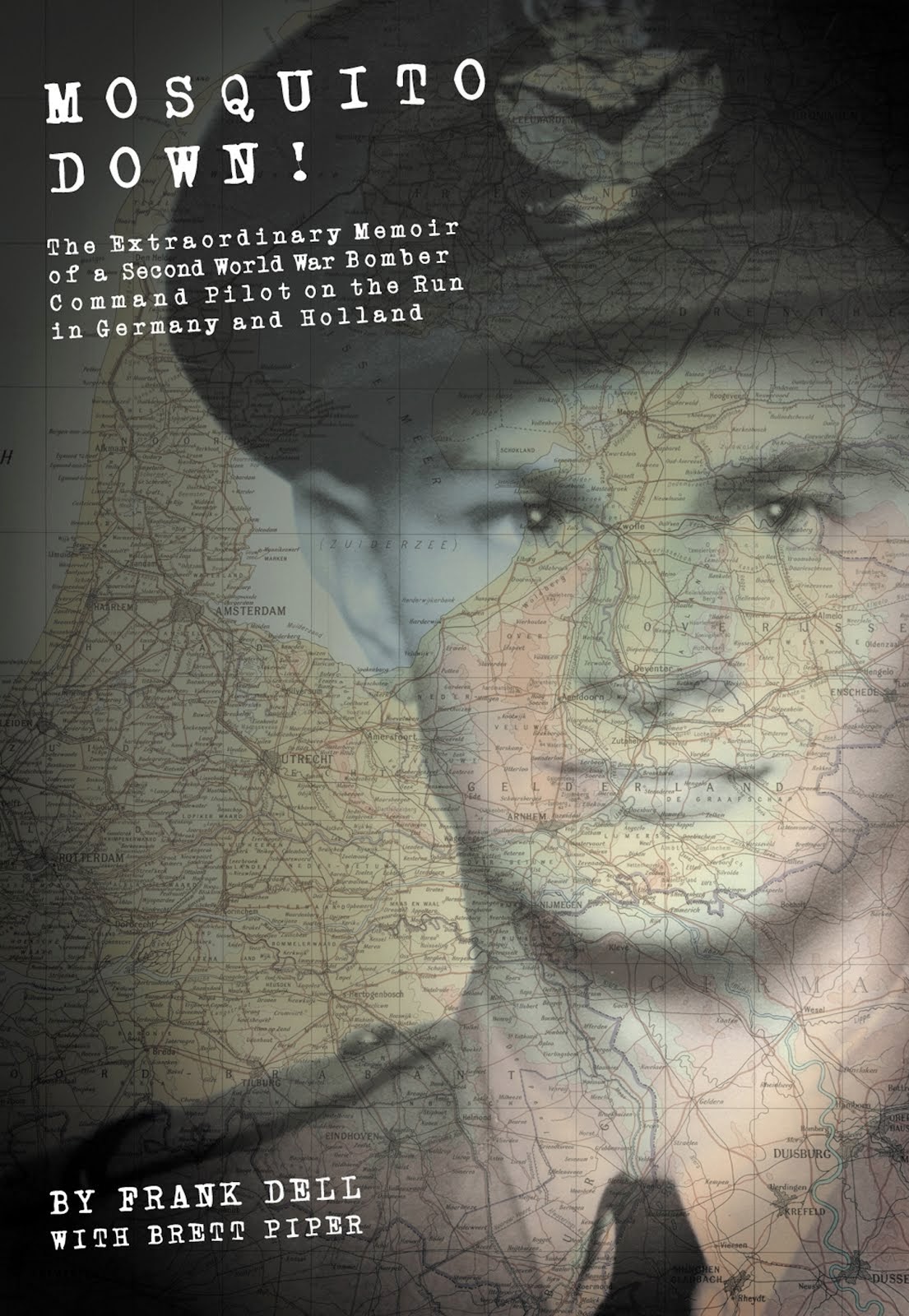
Mosquito Down! - Frank Dell with Brett Piper


There are a lot of Bomber Command books about at the moment.  I’ve said this before in previous reviews and ramblings.  Every second book in my reading and review schedule (“schedule” suggests order and discipline but there is very little of both!) is Bomber Command to the core.  This is great, and not before time, but I’ve discovered I can burn out on a seemingly never-ending diet of Lancasters, Halifaxes and Stirlings.  Sacrilege?  Perhaps.  Shooting myself in the foot?  Probably, but my passion ranges far and wide and, as many of you know, has a particular liking for the lesser known theatres and actions.  That said, put a Bomber Command book in my hand and I am happy.  Give it a twist and I am hooked.  Mosquito Down! did just that.

Frank Dell was the youngest of four children.  His father had served as a mechanic in the Royal Flying Corps during W.W.I after being deemed too old to fly.  He was badly injured by a spinning propeller but returned to the service as an engineering officer and was sent to Canada, and then to the US, with a team to set up training facilities for RFC pilots.  His son would follow in his footsteps to some extent.

The Depression had a significant and familiar bearing on the Dell family.  Two of Frank’s siblings were considerably older and had left home while the third was born with Down’s Syndrome.  Social propriety was a lot different to today and disabilities were very much regarded as an embarrassment more than anything else.  Both of Frank’s parents worked hard and the author provides a refreshingly open account of the extent of their love and care.  As the youngest he lived at home during the Depression period and was privy to the pressures his father prevailed against, to keep the family furniture business afloat, and the hard times other families experienced.  This understanding of the challenges faced by the average person led to Frank being a well-read and informed young man when Britain went to war.

He finished school at the end of 1940 and joined the RAF by way of a one-year university course that was advertised for those wanting a “long-term RAF career”.  Quite optimistic for that stage of the war!  Delayed by a stay in hospital at the end of his course, Frank was then sent to the US after soloing on Tiger Moths in less than 10 hours.

After being indoctrinated with the ways of the USAAF in Georgia, Frank completed his flying training at various airfields in Alabama.  He was selected to fly as an instructor so remained in the States until November 1943.  His thoughts on the USAAF ways of doing things, and Stateside life in general, make for interesting, albeit somewhat brief, reading.  Of particular interest is his mention of the infrastructure built across the US to enable airliners to navigate by radio beams.  He became very familiar with this system and the practice of ‘riding the range’.  It was experience that would stand in him in good stead when he finally flew on operations.

Frank had his mind set on flying Mosquitos.  With almost 1,000 flying hours under his belt he could choose what he wanted to do.  His experiences watching the Battle of Britain had him preferring a defensive role so, being a switched on and observant type who was aware of the loss rates among the bomber force, he volunteered for night fighters.  It was not until after the Normandy invasion, his training complete but no night fighter unit posting forthcoming, that Frank was interviewed by Hamish Mahaddie, selection officer for 8 Group Pathfinders, for a possible role flying PFF Mossies.  His beam riding skills notwithstanding, Mahaddie said he was ideal for the Light Night Striking Force and would have to complete 45 ops before being considered for the Pathfinders.  The LNSF Mossies, which carried 4,000-pound ‘Cookie’ blast bombs, were part of 8 Group anyway.  It was the chance Frank needed to fly Mosquitos and he didn’t need to be asked twice.

He took to the Mosquito well and fell in love with it easily.   Frank teamed up with his navigator, Ron Naiff, and was posted to No. 692 Squadron at the end of August 1944.  Ron had already completed a tour on Stirlings but the LNSF ops could not have been any more different.  Trips were flown at high altitude and were rarely more than four hours long, due to the speed of the Mossie, so by mid-October the Dell crew had already completed 12 ops.  They were shot down on number 13 … on Friday, October 13.

The target had been Berlin but they never made it.  Frank was ejected from the disintegrating aircraft but would not discover the fate of his friend Ron for quite some time.  Parachuting on to German soil, Dell struck out for Holland to the west.  After a week of sleeping rough, walking at night and an incredible number of close calls with German soldiers and civilians when, surely, the dark nights and bad weather hid his condition and identifying traits, he was discovered sleeping in a barn, in Aalten, Holland, a bare five miles from the German frontier.

What follows makes up the bulk of the book.  Frank is moved around several farming families and is integrated, after much vetting, into the local Resistance.  The author goes to great pains to describe, in his typical observant style, his Dutch friends and the conditions in which they lived during the occupation of their country.  The impact on his life, and the friendships he made, was perhaps greater than his time in the RAF.  It was six months of living on the edge, under the noses of a cruel and desperate regime, but among a hospitable and determined people.

Finally liberated shortly after the crossing of the Rhine, Frank, after the requisite leave, volunteered for transport work in India.  He returned after six months and, with no progress on an application for a permanent commission, left the RAF to join BEA in 1946.  He retired from British Airways in 1976 and remained active in the marvelous Escaping Society until it closed down in 1995.

The main focus of this book is, naturally, the author’s remarkable journey as an evader in Germany and Occupied Holland.  Do not expect great insight into the life of a Light Night Striking Force crew.  That said, the final op and a beautifully detailed account of the first operation are written about in depth (and are the only ops recounted).  The account of the first op covers every aspect of the entire process and, from what I can see, leaves next to nothing out.  This could easily have been a wordy list of “then I did this before doing that” but, such is the author’s ability to easily convey his experience, coupled with his observant nature, that the reader is completely absorbed from “ops on tonight” to crashing into bed post debrief.  It is business-like and matter of fact but cleverly written with the heart and mind of a lifelong flyer.

Speaking of fine chapters, and backtracking a little, Chapter Seven is a very good, concise discussion of the air war, and its technological developments by both sides, as it pertained to Bomber Command.  The author does not get bogged down in detail but manages, in a mere seven pages, to succinctly set the scene for his operational career.  It is necessarily short, and could have been so very much longer, but few could have done it better.

The author’s time with the Dutch Resistance is, however, what this book should be known for.  While he was not involved in blowing up bridges or other ‘Boy’s Own’ activities, thankfully, Frank was completely immersed in the day-to-day life of the local ‘cell’ and, once again coming back to his skill for observation and interpretation, the recording of this life is one of the more important and valuable accounts I have come across.  It is on par with David and Sydney Smith’s tale of The Comete Line in Lifting The Silence.  Happily, the book, through its photo sections, is able to give faces to the names of Frank’s many brave Dutch friends.  He kept in touch with some of them after the war and their post-war lives and fates, along with other ‘characters’ featured (like Ron Naiff), are given the space they deserve in one of the final chapters.  They were extraordinary men and women who melted away and, for most, simply became another face in the crowd.  Frank Dell has honoured their memory in no small way.

Dell wrote MD! “with Brett Piper”.  The latter’s influence is unknown but between them they have produced a book that sneaks up on you.  I was not expecting the expressive and open account of hiding in Holland.  The cover is understated but if you look carefully you will see the map is the area of Germany and Holland in which the author had his adventures.  The story is all there in his face and that map.  As expected, this is a well-designed and produced book although the angled text on the cover continues on the front and back flap and, in the confines of said columns, looks a bit odd.  It’s the first time I’ve had cause to stop and question a design aspect of a Fighting High book.

I cannot, however, and will not, fault the content.  Yes, this is Frank Dell’s wartime memoir but it could just as easily have been called “My Life with the Dutch Resistance” such is the breadth of his account and the honesty with which he tells it.  While not a huge book, at 169 pages of main body text, it punches above its weight and presents a much-needed tribute to the men and women of the Dutch Resistance.  Perhaps, like has happened with Bomber Command, more can be done to bring their service the wider acclaim it deserves.  Mosquito Down! has achieved this through the memories and respect of an old flyer who owes his life to them.

ISBN 978-0992620721

21 April 2009

Mosquito: Menacing the Reich - Martin Bowman

Martin Bowman has written extensively on the Mosquito and his latest effort is perhaps the most wide-ranging of them all. Through almost 300 detailed pages and more than 80 photographs, he explores ops across the whole gamut of Mossie ‘jobs’ – low-level strike, Pathfinders, anti-shipping, “Cookie” bombing, target marking, intruders, photo-recce, USAAF usage and, pleasingly, ops in the Far East.

Mosquito will appeal to all readers as it provides an excellent summary (for want of a better word) of just what this wonderful aircraft and her crews were employed to do. However, it is not infallible and I found the chronological blow-by-blow accounts of operations in each chapter occasionally hard to follow and, at times, suffering from the use of repetitive wording. The editing is of a reasonably good standard but falls away in the second half.

Beyond this periphery of minor ‘gremlins’, though, is where Mosquito really shines above anything I’ve read in recent months. Importantly, through numerous resources (excellent and very readable notes are provided in case you want to follow things further), the author has included many passages written or spoken by Mosquito aircrew. These range from anecdotes of several lines to entire accounts of raids that span several pages and make for fascinating reading. Looking at the book from this angle, the author has very cleverly provided the context, the skeleton if you will, and then let the aircrew speak for themselves to “flesh-out” the bones of the book.

The Mosquito and her aircrew have already achieved legendary status but Martin Bowman’s latest, while going over familiar territory, may just enhance that reputation.

I reviewed this title very late last year for Steve Darlow's Fighting High e-zine - http://www.fightinghigh.com/ - which is now being developed into a series of books.

The copy I have is a well-produced hardback by Pen & Sword and is available from their website and Amazon of course. There are many photos in the book including a surprising number of USAAF aircrew and Mossies.