The world of old comrades, now grandfathers galore, must be those of the gladiators of Rome – morituri te salutamas (We who are about to die salute you). Soon no man will survive to tell his story, and history is notoriously academic.
Established 2009. Reviews of books featuring aircrew of the RAF, FAA and Commonwealth air forces during the Second World War with occasional reviews of other titles covering the conflict.
The world of old comrades, now grandfathers galore, must be those of the gladiators of Rome – morituri te salutamas (We who are about to die salute you). Soon no man will survive to tell his story, and history is notoriously academic.
Rather fortuitously, and I am forever grateful for I have had my head buried in several manuscripts of late, this review was first published on Aircrew Book Review’s supporting Facebook page on 15 December. Colin Ford is the erudite ‘Historian by Appointment’ of No. 268 Squadron and the author of its epic history ADJIDAUMO - 'Tail-in-Air' the History of No. 268 Squadron Royal Air Force 1940-1946 (which will, hopefully, one day, be published as a widely available edition). His knowledge of the unit’s tactical reconnaissance work, and the intricacies therein, and intimate understanding of the careers of many of the pilots who flew with the squadron, makes him the perfect reviewer for a book about a ‘Spitfire Spy’. A couple of years ago I edited his comprehensive look at the only two Australians to fly the reconnaissance variant of the Hawker Typhoon (the FR.IB) into a 3000-word feature article for Flightpath magazine. The depth of his research was phenomenal and surely must be one of the very few (only?) comparisons of this version of the great ‘Tiffie’ with the almost ideal (for Tac/R) Mustang Mk.I/IA and Mk.II. Enjoy, then, this review written by quite the cluey chap! Andy Wright.
This biography of Flight Lieutenant David Greville-Heygate DFC has been written by his daughter, Sally-Anne Greville-Heygate, and is largely based around his personal correspondence, diary entries, pilot’s logbook, squadron records and other documentation. During the writing of this biography, where the source material didn’t contain, or the detail of what was noted in the source material was not clear to the author, she made good use of a number of aviation specific forums, especially ‘RAF Commands’, to post questions and seek answers.
The overall account is an interesting one and despite the publisher’s hyperbole of the subject—‘one of the few men who served in both the army and the Royal Air Force during the Second World War’—it was a more common occurrence than is generally known (my examination of the aircrew rosters of RAF Army Co-operation Command, and later Second Tactical Air Force Tac/R squadrons, shows a variation between units of 20-35 per cent of their RAF/RAFVR pilots at various times being ex-Army or seconded-Army). What we have is a story typical of many young men who had joined the Army just before or at the outbreak of the Second World War, who then answered the call for aircrew trainees from 1940 onwards. What is more interesting in this instance is the subject followed the path open to commissioned Army officers seconded for aircrew training with the expectation from the Army the role he would find himself in, when he qualified as a pilot, would be with one of the RAF's Army co-operation squadrons in support of Army operations and activities. Also, not surprisingly, a number of them did not always end up in the ACC or Tac/R type roles and could be found in the aircrew rosters of transport squadrons and Special Duties units, as well as being represented in smaller numbers in fighter, bomber and Coastal Command squadrons.
In David Greville-Heygate’s (DGH) case, completing his flying training in the UK, he passed through the Army Co-operation/Tactical Reconnaissance 41 OTU at Old Sarum and eventually joined No. 16 Squadron. There he initially flew Westland Lysanders in support of Army exercises in the UK, then when the squadron re-equipped with the Allison-engined North American Mustang Mk.I in April 1942, he flew the wide range of operational sorties being conducted by RAF ACC squadrons at that time. This included shipping reconnaissance, low-level photographic reconnaissance, Rhubarbs, Rangers and Populars, plus continuing support and participation in Army exercises in the UK including Exercise Spartan in early 1943.
In July 1943, with the disbandment of ACC, and the interim period before 2TAF was formed, there was the opportunity for him to sample the Supermarine Spitfire in the shape of the PR.IV. At that time, it was proposed 16 Squadron would move from the low-level to high-level reconnaissance role, however, due to a number of factors, that ended up being delayed so operations continued on Mustangs until early 1944.
In early November 1943, DGH was deemed to be tour expired and was sent to fill an instructor’s role at 41 OTU. That brought its own challenges and frustration, especially being ‘on rest’ when D-Day occurred. Seeking a way back to operational flying, DGH went down the path of converting onto the Hawker Typhoon, the demand for pilots for the 2TAF Typhoon squadrons being high at the time due to the number of combat losses. So, in early December 1944, he joined No. 168 Squadron flying the Typhoon largely on armed recces at low altitude over the Netherlands and western Germany.
However, due to a chance encounter with an old friend, and a bit of old fashioned ’string pulling’, he was able to get himself posted across to No.II (AC) Squadron (‘Shiny Two’), as a part of No. 35 (Recce) Wing, flying Spitfire XIVs. This is where he saw out the remainder of his wartime operational flying which included first-hand experiences relating to Operation Bodenplatte—the Luftwaffe attacks on Allied airfields on 1 January 1945—and the series of Allied operations, including the forced crossing of the Rhine, leading to the eventual defeat of Germany. Naturally enough, with hostilities over in Europe, there is the period of uncertainty that follows and the change from a wartime to peacetime Air Force, but with developing tensions with the Soviet Union in the areas of Europe they had occupied and the conflict still ongoing in the Far East.
There are a couple of areas in this biography where I felt somewhat uncomfortable reading his views on certain people. That partly arose from knowing a number of those people personally or, in a few instances, knowing the other side of the story as to why certain decisions and actions were being taken. For example, DGH objects to the demands for pilots to fly a certain number of hours and the introduction of specific training programs after VE-Day and berates his OC of the time regarding this. The OC, however, was following the TAF HQ/British Air Forces of Occupation requirements which dictated that aircrew who may be required for deployment to the Far East, or if the situation in Europe destabilised, were to maintain their operational skills and readiness through regular flying and training activities. This was not helped, of course, by the rapid drawdown in many squadrons caused by the repatriation of aircrew from Allied Air Forces (RAAF, RCAF, RNZAF etc) with the conclusion of hostilities in Europe.
As well, there are a few other places in the narrative where, given the focus of the biography, the bigger picture and the part DGH, and the units he was with, played is not particularly clear. Someone who may not have read about the role of ACC and 2TAF may be left wondering about certain aspects of what is conveyed and why things were done the way they were. As an example, the biography gives some detail of the low-level photography of the French coastline including Normandy conducted by DGH but does not explain the reasons for it, why this specific type of photography was required and why obtaining it was so risky for the pilots involved.
The other thing to be aware of is that, as a large part of the narrative is drawn from diary entries, letters and other documents of the time, some of the views and sentiments expressed by those at the time may seem out of place or somewhat incongruous in the current day; it’s all about how we view things now and how they were viewed then.
Photos from DGH’s wartime logbook and personal collection, plus those sourced from the family of wartime friends, combined with a number of photo extracts from the logbook and maps showing his key areas of operation, help round out and literally illustrate the story.
Overall, a good biography that is probably somewhere between autobiography and biography due to the high percentage of first-person source material used and the author’s obvious connection to the subject. For those interested in a different type of WWII pilot biography, and a view into a different part of the air war in Europe, this book will provide that difference.
ISBN 978-1-47384-3-882
While we have seen the release dates of a few books get pushed back for the various reasons that have made this year a tricky one, we’ve been very fortunate to see a steady stream of titles hit the market. As is now fairly standard, there has been a trickle of memoirs proper as time marches on for those who are left from the RAF and Commonwealth air forces of the Second World War. The closest we have now really are, of course, the biographies written by family members. Regular readers will know I have my moments with these books as some are well done, with considerable effort made to understand the world of eighty years ago, while others feel like they have been thrown together. I can be critical of such things, yes, but at least the interest is there to share the story. There’s always something to learn!
Several biographies relevant to ABR have dominated the social media scene purely because they have enthusiastic authors behind them. I’ll say ‘dominated’ but no doubt there’ll be one you haven’t been aware of! Rosemary Parrott’s The Pilot in the Poster, Jane Lowes' Above Us, The Stars and Henry Meller's The Boy With Only One Shoe (written with his daughter Caroline Brownbill) have seemingly popped up everywhere and at least the latter two have received some attention from the popular press. I’ve only read the Parrott book to date, however, and it’s quite the ride (in Peter Parrott’s own words) that ranges from the Battle of France to Italy, post-war test flying and beyond. The initial print runs have done exceptionally well, and Peter’s daughter, Rosemary, is continually improving the manuscript. This book has a bright future with a new edition with better distribution forthcoming.
Two books popped up in the past week and both couldn’t be any more different in subject matter. The first one I was made aware of came via an email from the compiler/editor. James Dunford Wood is the author of the A Story of War blog that, several years ago, finally finished seven years of diary entries; it followed ‘one man's war day by day, 70 years on, from Waziristan and the North West Frontier, Habbaniya, the Burma campaign, India & the Rhine’. That man was James’s father, Colin Dunford Wood, who initially served in the Army on the NWF before cheating an eye test to train as an RAF pilot (that’s the Habbaniya, Burma, India and the Rhine bit!). James has now released the first volume of Big Little Wars covering India and Iraq from 1939 to 1941. At the moment, it’s a limited run available on Amazon, but, as you can see from the blog, the entries are fascinating and have a sense of immediacy about them (along the lines of Andrew Millar’s The Flying Hours, but ultimately wider ranging). The other book to recently ‘appear’ is Ian Redmond’s Bloody Terrified. It’s ostensibly the story of his dad, Canadian navigator Colin Redmond, but time spent with his pilot has immensely fleshed out the story to the extent it’s now ‘the true story of a Pathfinder crew’. That’s a 608 Squadron Mosquito crew of the Light Night Striking Force. If that’s not enough to sell the book to you, nothing will! I have not seen Big Little Wars or Bloody Terrified, but probably will after Christmas. We’re lucky to have new material like this, so let’s support it!
I’m currently still reading Adam Lunney’s We Together, the story of Nos 451 and 453 Squadrons and their contribution to the war in greater Europe. I say ‘greater’ as 451 spent a few years in North Africa and the Middle East before moving to France. You might remember 453 Squadron’s time in Normandy was the subject of Adam’s first book, Ready to Strike, and We Together is more of the same, but this time drawing together the threads of two units and better presented due to the collaboration with Mortons Books. I’m still reading it as I’ve had to tackle several manuscript edits, and even a new book for review, with time critical deadlines. Reading for fun or the usual review stops when there’s work-work on!
Speaking of squadron histories, a book from late 2019 I've only just managed to acquire is Through to the End by David Palmer and Aad Neeven. This is the story of 487 (NZ) Squadron RAF and its wartime flying of Lockheed Venturas and DH Mosquitos. The detail and heart evident in the narrative is a beautiful mix of Palmer's 'storyteller's flights of fancy' and Neeven's 'advocacy for hard historical fact'. It's a big book, published in the Netherlands by Neeven, and my leading contender for aircrew book of the year. There’s a more detailed review here.
Another big book that got worked me up into a lather is Edward Young's The Tenth Air Force in World War II, published by Schiffer Military. It is phenomenal, not perfect, but there's never been something as comprehensive as this when we're talking the USAAF in India and Burma. The Tenth Air Force worked very closely with the RAF, in case you’re wondering about relevance to ABR, and the book features a substantial number of images and information pertaining to the work of the RAF and Commonwealth air forces in the region.
While we’re on the subject of American-based titles (let’s get them out of the way!), Jayhawk by Jay Stout with George Cooper, and published by Casemate, will have you hooked if you have even the slightest interest in low-level B-25 Mitchell strafers. Cooper grew up in the Philippines and eventually flew strikes against Rabaul et al, hence the regional interest from this end. It makes a nice addition to the recent list of strafer books, including Stout’s own Air Apaches and John Bruning’s excellent Indestructible. On the other end of the scale is the sobering No Way Out by Steven Whitby. Another book from Schiffer Military, this is the (not quite so) untold story of the ‘Lady Be Good’, the B-24 Liberator lost in the desert and found decades later. A lot of aspects of the discovery in this book are very familiar, but it’s the detail of the following USAF expeditions to find the crew, and the phenomenal and haunting images they produced that pushes this book above its predecessors.
It wouldn’t be a report on highlights unless there was some Fleet Air Arm content! The biggest success this year is no doubt Rowland White’s Harrier 809. He knows how to tell a story. The great ABR news of the year, however, has been the relatively recent release of two books from Matt Willis (he of Flying to the Edge and the Edmund Clydesdale trilogy and, incidentally, the artist behind my ABR Christmas cards sent out as a small thank you to those I have worked with this year). He's written the first instalment of Mortons Books 'Fleet Air Arm Legends' series—Supermarine Seafire—and has written the second (Fairey Swordfish), while Key Publishing has also just released his Fairey Firefly book. Both are slim volumes (think Osprey Aircraft of the Aces), but they pack a wallop.
Hikoki Publications released the first volume of Vic Flintham's Close Call - RAF Close Air Support in the Mediterranean. This is a subject we needed covered well. Don't be put off by the 'Defeat in France' on the cover of a Med book as it also looks at the evolution of close air support. Have to start somewhere! I'm already looking forward to the second volume next year. Other much anticipated books are Resolute from Fighting High (the George Dunn DFC and Ferris Newton DFM story), the third volume of the great series Greeks in Foreign Cockpits, South Pacific Air War 4 (the fourth book of a planned and very successful trilogy!) and Eagles over Darwin from Australia’s Avonmore Books, Anthony Cooper’s Sub Hunters, and the great David Hobbs's Taranto and Naval Air Warfare in the Mediterranean 1940-1945 (if you want something a little lighter, try Lowry and Wellham’s The Attack on Taranto; that will set you on the well-trodden path to Charles Lamb’s War in a Stringbag, let it happen!).
Finally, I'd like to give a shout out to the RAAF for their new Air Campaign series and its first book Armageddon and Okra, comparing Australian military aviation involvement in the Middle East a century apart (the second addition to the series is already well advanced and looks at a conflict in the fifties). Indeed, with the Royal Australian Air Force celebrating its centenary in 2021, keep an eye out for an impressive range of titles. Kathy Mexted, the author of Australian Women Pilots, also deserves much praise. Her book, a collection of original biographies of female aviators from all walks of life and all periods of Australian aviation is selling like hot cakes because, besides the subject matter, it is wonderfully written and carefully researched.
Well, it’s been a fun year, not without its challenges, but I’m glad you’re reading this. Season’s greetings to you and yours and all the best for 2021.
Tom Lewis was there from the start, co-authoring Zero Hour with owner Peter Ingman. They followed up with Carrier Attack Darwin 1942. Tom published several other books with Avonmore, The Empire Strikes South for example, and Peter joined forces with Michael Claringbould for the South Pacific Air War series (Volume 4 coming soon!).
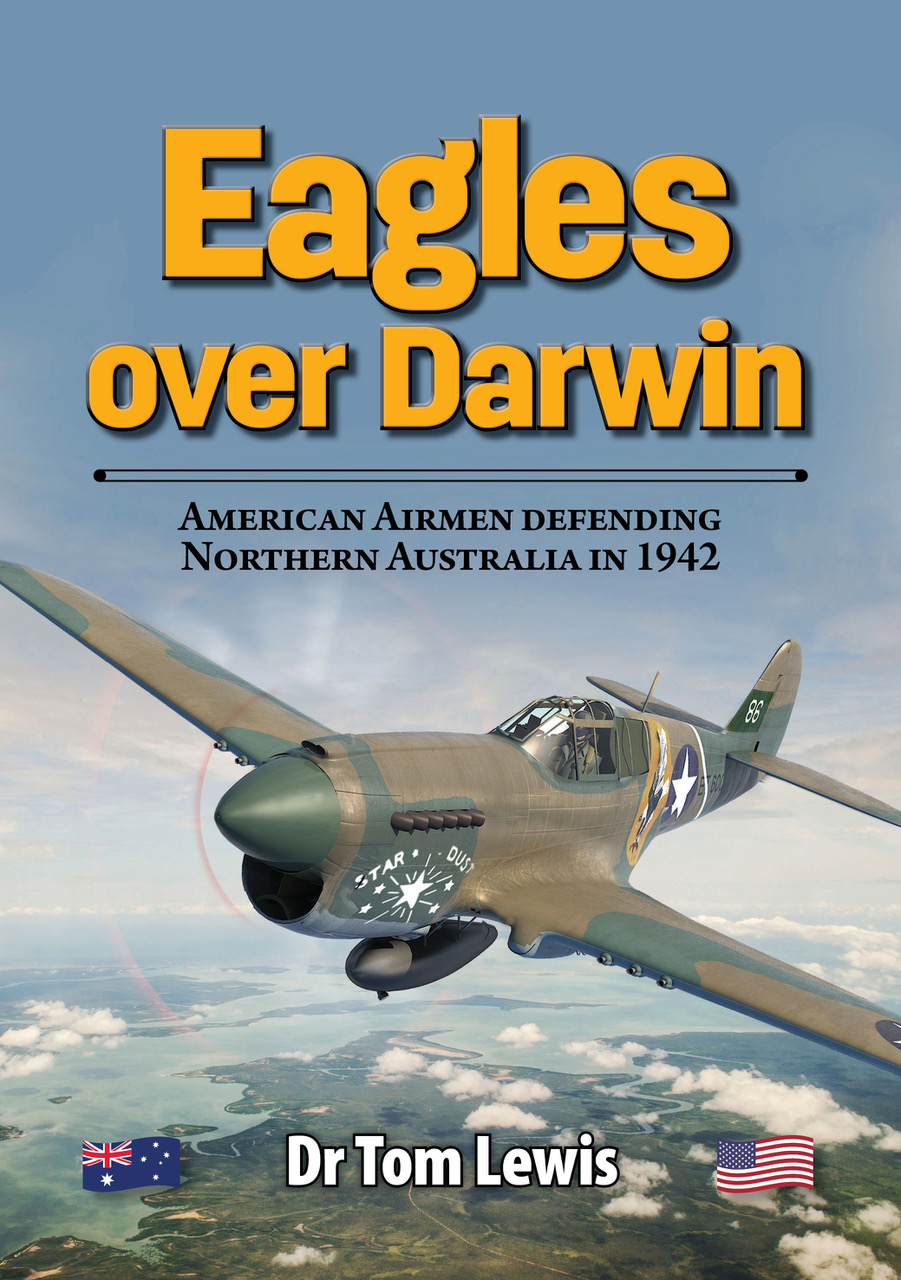
With Eagles over Darwin we see Tom return to the very first air combats over Australia as it and its allies reeled in the face of the Japanese onslaught. From the back cover blurb:
A massive Japanese attack on Darwin on 19 February [1942] had left the town and its air base in ruins. An understrength squadron of USAAC P-40E Warhawks had fought a gallant defence but was all but wiped out.
Northern Australia was now at the mercy of Imperial Japanese Navy Betty bombers and Zero fighters whose crews were both skilled and experienced. However, help was on the way. The 49th Fighter Group was the first such group to be sent from the US after the start of the Pacific War. Its destination was Darwin.
From modest beginnings on make-shift airstrips, the 49th FG entered combat with its feared Japanese adversaries. Its P-40E Warhawks were poor interceptors but were rugged, reliable and well-armed.
Over several months the 49th FG pilots fought a brave and innovative campaign against a stronger enemy that did much to safeguard Australia in its darkest hour. Today, lonely and long forgotten airfields still bear the name of American pilots who made the ultimate sacrifice.
This is going to be an important book when it's released. I don't think much has been written on the subject, about American Warhawks defending Darwin, for a few years, and the last book I can remember reading on the subject was James Morehead's In My Sights. The most recent work I can think of is the well-regarded Darwin's Air War by Bob Alford. The Ferguson and Pascalis Protect & Avenge is perhaps the largest work on the 49th FG, but, a product of the mid-nineties, it's getting long in the tooth now and can be found wanting. Tom Lewis has been investigating Warhawks ops over Darwin for a while now and uncovering new information that will surprise and, as usual, challenge. A vignette of Australia's defence, and USAAC/USAAF history, very much deserving this treatment.


Last year was quite exciting for a wartime Royal Navy Fleet Air Arm tragic. Hot on the heels of David Hobbs’ then latest work, The Dawn of Carrier Strike, came a book any aircrew enthusiast could get excited about: a title about the Grumman Hellcat-equipped 5th Fighter Wing. A book on the subject was incredibly welcome and, considering some of the recent attention and study directed at the British Pacific Fleet, would bring some of the ‘forgotten’ men of ‘the forgotten fleet’ into focus. Heaven High Ocean Deep certainly does that, but in doing so it ignores everything brought to light in the past three decades (at least).
One of the great traits of the wartime FAA was adaptability. This was born mostly out of having to face the odds with aircraft that were either of ‘another era’ or pressed into an environment for which they were not designed. Hamstrung from well before the outbreak of war, due to the RAF’s desire to control military aviation into the thirties, and an Admiralty in love with the ‘big gun’, the Fleet Air Arm did what it could with what it had. What it achieved with its biplane torpedo bombers, hastily converted land-based fighters, and two-seat long-range fighters, in the first years of the war is legendary. The effectiveness and flexibility of the carrier strike force began to hit home and the Americans and Japanese massively reinforced that point in the first year of the war in the Pacific. The British aviation industry, already pushing hard, could not hope to fulfil the FAA’s resulting need for more, and new, aircraft. The US, however, was beginning to pump out aircraft. The Hellcat—with its rugged construction, docile landing characteristics and excellent forward visibility—was a development of the Wildcat (also used effectively by the FAA) and Grumman refined the design as encounters with the Japanese ‘Zero’ were analysed. Its simplicity meant it went from drawing board to carrier deck far quicker than the troubled Corsair, a design that had flown before the US entry into the war. The Hellcat, as mentioned above, settled into the USN easily and became so well established that by the time the USN had carrier qualified its first two Corsair units in 1943 (before the RN received its first Corsairs), commanders in the Pacific didn’t want the headache of another fighter requiring yet another supply chain of unique spares. The US Marine Corps were happy with the ‘surplus’ of Corsairs and, despite the type’s tricky handling, so did the RN, recognising the bent-wing fighter offered a significant jump in capability. Its issues would be dealt with and made to work in typical FAA style.
The RN went for the Hellcat at the same time and the 5th Fighter Wing came into being in late 1943. Only two squadrons, 1839 and 1844, made up the Wing due to a shortage of pilots and space considerations on board HMS Indomitable, the assigned fleet carrier. They worked up in Northern Ireland before embarking on an escort carrier in February 1944. The loaded-to-capacity carrier took them to Colombo where they finally met, and started flying from, Indomitable mid-year. The Royal Navy’s pivot to the Indian Ocean, which it had never left despite the reversals of 1942, was well and truly underway (as was its return to a legitimate role in the Pacific). The fleet began to make forays to Sumatra, initially hitting lightly defended targets before going after the oil refineries from late 1944. These raids—the inexperienced Hellcat units were left off the early ones, with the exception of the photo-reconnaissance Mk.IIs—revealed a lot of issues from beginning to end of a strike (excessive time taken to form up, control over the target etc), and these had to be ironed out, to the satisfaction of the Americans, some of whom weren’t keen to bring the RN into ‘their’ theatre, before the fleet arrived in Australia to establish itself as the British Pacific Fleet.
That arrival in Australia followed the well-known raids on Palembang in late January 1945. By the end of March the now accepted BPF had begun its attacks on the Sakishima Gunto, an island chain pointing the way to Formosa (now Taiwan) from Okinawa. Its role was to prevent Japanese aircraft, many assigned for kamikaze attacks, using the islands to hop from Taiwan to the US invasion fleet at Okinawa. It was hardly a glamorous job, the fleet’s aircraft, Hellcats included, hitting the same airfields and installations time and time again, and at quite a cost, withdrawing to re-supply from the fleet train, and then returning to do it all over again. This was kept up until late May. The return to Australia, to prepare for attacks on the Japanese Home Islands, meant the end of major operations for the 5th Fighter Wing. Only its specialist photo reconnaissance and night fighter elements would see combat with the BPF to the end of the war. The PR pilots were particularly hard pressed and returned excellent results.
The above is a barely potted history of the BPF’s activities. It, obviously, doesn’t include that most vital component of any unit history—the human element; the memories of the people involved. Fortunately, Heaven High Ocean Deep leans heavily on a number of veterans interviewed by the author, inspired by his father and godfather both being wartime naval aviators, during the 1990s. The book is built around these interviews. They span the range of experiences, from joining up all the way through to the end of the war and demobbing, and sees several interviewees quoted throughout the book. There are some valuable passages looking at the operational side of things, and the steep learning curve, but also several that reflect on losses and their impact. Diary entries abound, but there is little, save the acknowledgements, to indicate the extent of other records referenced as there is no bibliography. Indeed, only three secondary sources—in the form of Winton’s The Forgotten Fleet, Hanson’s superb Carrier Pilot and Admiral Vian’s Action This Day—are directly mentioned, the youngest of these first being published in the late seventies. The work of John Winton, who the author was in contact with and whom he received completed research from, appears to underpin the entire narrative. Fair enough, it was a ground-breaking work, but doesn’t stack up to the claim ‘it was and remains the most important account…’ as that accolade now sits with The British Pacific Fleet by the aforementioned David Hobbs. That’s probably the theme of the major issue with this book. All of the research is at least two decades old and a good chunk seems to rely on work from the 1960s. Granted, history doesn’t change, but new analyses and discoveries greatly enhance its understanding and to ignore recent ‘developments’ is akin to sticking your head in the sand.
It can also lead to repeating information since disproved or, at least, incomplete. Early on there is a suggestion the RN led the way with the operation of Corsairs from aircraft carriers, even mentioning the nickname ‘Whistling Death’ which has since been understood to be a creation of the manufacturer’s marketing department. As mentioned above, the USN had carrier qualified Corsair units before the RN even received its first aircraft. Yes, the FAA developed modifications and improved techniques to operate the Corsair at sea, but it was not the pioneer. Similarly, there is also a discussion regarding the preference for American types because the USN Pacific supply chain could be relied upon for replacements. One of the requirements for the RN to operate alongside the USN against Japan was it had to be self-sufficient. That’s why there was a mad scramble to assemble supply ships for a fleet train that ultimately stretched from the east coast of the US across the Atlantic to the UK and then east to the Indian Ocean, Australia and beyond. Then there’s the extensive modifications the RN made to its aircraft.
Opinions and analysis seem to be largely driven by the comments made by the interviewees. If a veteran says ‘It was a bloody waste of time’ (I’m paraphrasing) in reference to an exercise or raid, it’s taken as gospel. There is no attempt to prove it was or wasn’t. The bigger picture of everything leading up to the BPF was to prove to the Americans the RN was good to go, was capable of effective, standalone strike operations. Similarly, the attitude of some of the veterans to Admiral Vian seems to have rubbed off on the author. I’ve not read a lot about the man, but to say he didn’t care for the men under his command is too much. My first thoughts upon reading that was to recall the efforts he made to recover downed airmen, including sending a Walrus to a Sumatran lake, at a predetermined time and date, in case evading flyers had managed to make it there as briefed. That means keeping the fleet within range, and therefore in danger, so the Walrus could make it back. Hardly heartless.
As usual, a ‘hook’ to open the book—something exciting to draw the reader in—would have been good to see. Hanson’s Carrier Pilot is quoted and that opens with one of the most perfect hooks I have read. The author’s godfather shared a kill during his time as a Hellcat pilot and that would have been ideal to open the book with.
This is a beautifully produced book from Casemate. Black and white photographs are liberally sprinkled throughout, many featuring men mentioned in the narrative. There is also a superb glossy colour photo section that brings everything to life. Combined with the veteran interviews and ‘real time’ diary entries, the more than 125 photographs included in this 210-plus page hardback work hard to make up for the out-of-date, unbalanced narrative. Heaven High Ocean Deep could have ranked with the best of the current crop of FAA authors (Hobbs, Willis etc). Sadly, it falls disappointingly short.
ISBN 978-1-61200-7-557
Two days, two Bomber Command book arrivals, both written by somewhat removed relatives. Same, same, but different. Two approaches to presenting a similar tale. Both allow the reader to ‘know’ the ‘hero’.
Jane Gulliford Lowes’s Above Us, The Stars is one of two new English Bomber Command biographies receiving a good dose of attention at the moment (the other being The Boy With Only One Shoe by John Meller and Caroline Brownbill). Above Us, The Stars is Jane’s investigation of her great-uncle’s experiences with 10 Squadron RAF. Jack Clyde was a Halifax wireless operator and completed his tour in early March 1944.
The author uses a creative narrative to tell the story, along with a tonne of references (and ten veterans personally interviewed, one of the first things I checked was the bibliography), and goes to great lengths to accurately portray the world these men inhabited. Little is left wanting in terms of understanding the stresses they went through with what appears to be a good study of the threat of being deemed LMF (Lack of Moral Fibre) supported by numerous comments from primary and secondary sources. The members of the crew, and specifically Jack Clyde of course, are also placed in social settings as readily as the familiar operational environment. This allows a greater understanding of their lives and gets them under the reader’s skin.
The second book to arrive was Over the Alps by Moonlight. This is a series of letters and aerographs written by Australian Lancaster pilot (12 Squadron RAF) Robert Yell and compiled by Susan Yell (his niece). An older publication, released in 2009, its approach couldn’t be any more different from Above Us The Stars. Instead of building a narrative, Susan wrote an excellent, well-referenced introductory ‘essay’ that sets the scene while also laying out Bob’s journey in detail not included in the letters. Other than single line entries from the logbook, interspersed between the letters as time progresses, Susan lets Bob do the rest. The correspondence is mostly from Bob to his parents, but also includes replies and letters to/from several other relatives.
There is very little in the way of operational detail in Bob’s writing, for obvious reasons, so there isn’t a lot of hard evidence as to how he was getting on. Certainly, he was working and playing hard. He was clearly keen to reassure his family he was okay. There is one indication as to the mounting pressure he was under, however. He wrote 51 letters, averaging one a week, up until he started flying on ops. For the six months of his tour, from 24 July 1943 until he was lost on his 30th trip on 14 January 1944, he wrote just seven letters and preferred the shorter format of the aerograph (seventeen in all, a brand new method for mail to Australia in 1943). No doubt busy on ops and then busy wanting to relax and forget it all on leave.
Bob’s letters regularly include mention of what was making news of the time, nicely placing him in context. Other than a few photos, the collection of letters (handed down through the family over time), the headstone at Hanover War Cemetery, and perhaps the DFC he was awarded (for a ‘shaky do’ over Berlin on 26 November 1943), there is little to remember Bob by so this book is greatly valued.
As a lovely piece of serendipity, I noted, while flicking through both books, Jack and Bob were both operational at the same time, albeit Jack had a few ops to his credit before Bob got underway. A quick look revealed they both flew on the 24 July Hamburg raid, the first op for Bob and his crew. There may have been other nights when they attacked the same target, but I haven’t gone that deep yet. It was just nice to consider here were two books, written years and half a world apart, deposited on my doorstep within a day of each other, and featuring men who shared the same patch of night sky over occupied Europe on at least one occasion. That the books exhibit two different styles of story telling shows the variety that can be employed if the effort is made to really understand how the subjects lived, the skills they developed and used, what they experienced and how it affected them. That, surely, is the greatest way to honour their memory.
Several years after his myth-busting Paddy Finucane and the Legend of the Kenley Wing, the next instalment of Anthony Cooper's Australian aircrew books is finally, almost, with us!
Anthony is perhaps best known for his superb Darwin Spitfires. He followed that book with Kokoda Air Strikes and RAAF Bombers over Germany 1941-42 and the aforementioned Kenley Wing title. This new book continues his look at where Australian aircrew were around the world during 1942, when our UK-based Spitfire squadrons were ordered home to defend northern Australia from Japanese air raids.
Cooper is an erudite type with a fine analytical mind and a penchant for not accepting things at face value. This approach was most evident with Darwin Spitfires, revealing the moderate successes of the squadrons (as opposed to the raging, almost colloquially so, success that is often repeated) in the face of technical, tactical and logistical deficiencies, and Kenley Wing, again proving all was not as was flagrantly reported and recorded to become legend. It must be noted there is never a lack of respect in these exceedingly well-written narratives, but the discussion is always frank and fair. There is no doubt the same will apply to Sub Hunters.
While not so much the stuff of repeated exaggeration, the Australian Sunderlands have not had anything written about them to this extent, excluding a couple of memoirs, since Norman Ashworth's The ANZAC Squadron (about 461 Squadron). The most prevalent story, besides one Sunderland versus eight Ju88s for example, is, of course, the sinking of U-boat U-461 by Dudley Marrows and his crew (flying Sunderland 'U' from 461 Squadron). There is so much more to the two squadrons (10 and 461) than these events. Anthony Cooper's intimate knowledge of the German language will have no doubt been put to good use examining records of such Luftwaffe heavy fighter encounters with the Sunderlands over the Bay of Biscay.
Besides the finely crafted narrative, this Fonthill publication includes a rare thing in this publisher's catalogue of aircrew books - an index! It's the type of book that certainly needs one so it is pleasing to see space was allowed to include it.
Coastal Command is not something I get to write about too often in the context of Aircrew Book Review. I am over the moon I get to now (and again in the future) and that it's from the pen of Anthony Cooper. Alongside the recent announcement of David Hobbs' latest book, we have another much anticipated literary highpoint for a rather challenging year.
Andy Wright