22 December 2021

2021 - a year in review

Right, so, for the past few years, in the lead up to Christmas, I’ve been asked to contribute a recording or list of my ‘books of the year’. This invariably dribbled on a bit to include books I was looking forward to. I’ve had my head buried in manuscript edits, hence my utter failure on the review front for the website this year, and have suddenly realised I haven’t been asked to do a list this year (probably because of the aforementioned dribble). Therefore, I’m doing one now! While I’ve edited manuscripts across an array of subjects in 2021, I will, of course, only (mostly) mention those that are relevant here. Of course, by the time you read this, unless you happen to jag next day delivery or whatever other 21st century postal malarkey I’ve never seen, it will be too late for a pre-Christmas arrival. However, any good book person might expect Christmas money or book shop vouchers from Santa or the family. A book arriving early in the new year, or any time for that matter, is just as good!

Where to start? As an Australian, the biggest impact on the market here has been the books released by the Royal Australian Air Force’s History & Heritage Branch. This second year of lockdowns, vaccines and isolating was also the centenary of the RAAF, the planning of which was years in the making. Many events were cancelled, including airshows and book launches, but the H&H Branch, in particular, pressed on with its new releases. All were produced by the Branch’s publishing partner, Big Sky, and have reportedly sold well, partly due to their favourable pricing but mainly because of their incredible content. Aircraft of the Royal Australian Air Force and Sky Pilot were the only two to directly cover the 1939–45 period but, even then, only in part. The latter is an updated and revised edition of an early nineties title about the RAAF’s chaplains. The biggest success of the year, and probably the best aviation seller nationwide, was Aircraft of the Royal Australian Air Force. This 600-plus page hardback details every aircraft type (150 of them) to wear the RAAF’s A-series serials. Heavily illustrated and written by a swathe of subject-matter experts, this massive book has set the bar high. 

To close out H&H’s 2021 releases of Cold War Warriors (Australia’s P-3 Orion era to the early nineties), Malayan Emergency and Indonesian Confrontation (self-explanatory) and the new edition of From Controversy to Cutting Edge (Australia’s history with the F-111), another centenary title, Then. Now. Always., is starting to hit shelves and letterboxes. An illustrated history of the RAAF’s first century, this is another large book that is very attractively priced. Next year will feature a bit of a maritime theme so, if you like Australian Sunderlands …

The aforementioned Big Sky Publishing continued its resurgence in aviation history and released Bombs and Barbed Wire and Best of Times, Worst of Times, both by Jeff Steel. I have yet to read either, and have very little idea what they’re about (the latter does look at the wartime careers of two flyers with very different paths, hence the title), but if you like your Bomber Command tales then these are worth a go. On that subject, one of two exciting releases for Big Sky early in 2022 (January) is Ian Campbell’s Thinks He’s A Bird. Here we have a Queensland postal clerk become a Pathfinder pilot. The narrative is exceptionally well done with the author having access to his relative’s detailed diaries and letters. Strong to Serve, the second early 2022 (February) release from Big Sky is by first-time author Joseph Mack. It tells the story of Fred Riley, an English-born Australian who flew Spitfires over the Normandy landings and chased V-1s over England before living a frenetic existence on the Continent in late 1944. What’s the only thing better than diaries and letters? Firsthand interviews. Strong to Serve’s foundation is a series of interviews between Fred and the author with everything else skilfully weaved around to create a fine biography. Before I forget, Big Sky also has Viking Boys almost ready to go. Beaufighters and No. 455 Squadron anyone?

Since we’re talking about Australian aircrew books, it has been quite the bumper year (the 2022 Anzac Day list is looking healthy). It looks like Geoff Raebel may finally release his delayed Sink the Tirpitz in 2022. Some of you may be familiar with his The RAAF in Russia and I believe this is similar but now includes a number of images of Hampdens not previously published. Michael Veitch’s latest book, The Battle of the Bismarck Sea, came out mid-year and is his best yet. While I’ve seen some press about that title, and have yet to write my own review, I’ve seen nothing about the new edition of Colin Burgess’s Australia’s Dambusters which was released at about the same time. It’s quite odd as it’s really nicely done by a major publisher with a good network and pricing.

Two privately published Bomber Command memoirs caught my eye recently. I’m currently reading the most recent one, I’ll Be Back for Breakfast. It is the story of Edgar Pickles DFC*, a Lancaster pilot with Nos. 100 and 550 Squadrons, and is a finely crafted tale that is, unfortunately, frustratingly, littered with technical and historical errors pertinent to Bomber Command. If you can get by them (they will be fixed), it’s actually a really good read. The slightly older title, Full Circle, printed by the good people at Digital Print Australia, long-time supporters of ABR, is a daughter’s tribute to her father, Howard Hendrick DFC, as No. 460 Squadron and BOAC flyer. I’ve spoken at length with the author (as I have with Pickles’s daughter) in South Australia and she said the book is selling well locally. I’ve yet to read it, and may not immediately as I’m coming off a string of Bomber Command titles and need a change of subject, but it again appears well written (and there’s no glaring errors leaping off the pages). I’ve at least convinced the author to get DPA to sell the book via their website, a service they offer for all the titles they print. Oh, keep an eye out for Don McNaughton’s Lucky Pommie Bastard too.

Before leaving Australian-centric books, don’t forget about Avonmore Books. Their South Pacific Air War trilogy has turned into four volumes, soon to be five, and there is a promise of another Pacific campaign series on the way. Watch out for some very Western Australian history with Ian Duggan's Black Swans over Java. It's available from the publisher, Hesperian Press, but Avonmore also has stock.

I’ve also recently finished Will Iredale’s The Pathfinders and found it an ideal way to refresh basic knowledge of the PFF. A good chunk of a book, the narrative skips along nicely, perhaps too much over the technical stuff, but this is indicative of the more general audience it is written for. It certainly keeps the focus on the aircrews, however, which is the point of the whole thing. This is one of those landmark books that can be remembered for sending readers down the rabbit hole.

That rabbit hole will lead to the likes of Fighting High Publishing, Grub Street and Bomber Command Books. Fighting High has continued along quietly, most recently releasing typically beautifully produced books like Resolute, Extremes of Fortune and The Lost Graves of Peenemünde. I’m not quite up to speed with what books Fighting High has planned for 2022, but they’ll be worth adding to your shelf. Grub Street has added to its Boys series with Fleet Air Arm Boys, Groundcrew Boys and, more topically, the paperback edition of Beaufighter Boys. I’ve also just received a copy of Andy Saunders’s Dowding’s Despatch, a very heavy 220-page hardback featuring Dowding’s history of the Battle of Britain fleshed out by Saunders and heavily illustrated with less well-known images of the era. Not your normal BoB book which is quite the relief to be honest. Before we leave Grub Street, find a copy of Gavin Hoffen’s Restoration Force to understand hard core aviation obsessions! I’d argue books are less mobile in some cases though! Meanwhile, Bomber Command Books, Simon Hepworth’s publishing house, has had a flurry of releases in the second half of the year. I’d like to say I’m impressed with The Battle of the Barges and Steve Smith’s No. 218 Squadron histories, Courage was not Enough and In Time, but they’ve been intercepted for Christmas! If the revised and updated editions of Chris Ward’s 467 Squadron RAAF and David Gunby’s Sweeping the Skies are anything to go by, they’ll be well received albeit while causing more headaches for the rapidly shrinking available space on the large format shelves.

Sean Feast has been published by all three of these publishers in the past year or so and, as a favourite, currently writing author, regularly consumes shelf space. I was just about to say I need to add his recent Halton Boys (by Grub Street) but turned around and saw it on the shelf. I don’t have a problem. Not at all. While other favourites like Anthony Cooper, Kristen Alexander, Graeme Gibson, Steve Darlow and Peter Ingman are neck deep in other projects, authors like David Hobbs and Matt Willis have pending releases, The Fleet Air Arm and the War in Europe and Fairey Swordfish (Fleet Air Arm Legends Book 2) respectively. Hobbs is, well, Hobbs, and always worth getting excited for, while Willis goes from strength to strength across a variety of genres, subjects and formats (he published the third Fortress of Malta novella this year as well). He has massively increased his back catalogue with Key’s Fairey Firefly and Mustang: The Untold Story, and the first volume of Tempest Books’ Fleet Air Arm Legends, Supermarine Seafire.

Finally, two things to remember. Keep an eye out for Air War Publications’ two-volume history of No. 450 Squadron RAAF. Each book is going to be a large format hardback and will be to a standard, for Australian squadron histories, we have never seen before. Be patient, as the principals have day jobs, but their work with Doug Norrie will set a new standard. Also, I know Pen & Sword has copped a bit of stick lately with regard to poorly edited books, questionable research and author dealings, but they are still producing quality work (like Hobbs through their Seaforth imprint). Keep an eye out, especially on their coming soon listings.

Well, there you have it. Looking back, looking forward, there’s aircrew books aplenty and always the possibility of the next holy grail or unknown title find. I hope it’s a fine copy, affordable and everything you hoped for when you finally settle down to read it.

20 July 2021

Luck and a Lancaster - Harry Yates DFC


Well, I'm still struggling to find the time to get reviews written, despite the increasing stack of finished books accumulating on one end of the desk. I am planning a return to 'Monday review writing' but that assumes I can continue to manage the manuscript edit deadlines. It is good to be busy! Anyway, I've pulled a guest reviewer out of my quiver and he's pointed himself at a very worthwhile target. Robert Brokenmouth, intrepid local music scene reporter, auction house denizen, and raconteur, has appeared on ABR before as a reviewer but, more importantly, as the editor of new, annotated editions of the Australian bomber aircrew classics 'They Hosed Them Out' and '101 Nights'. His work on these titles produced two of the greatest additions to wartime aircrew literature of the 21st century. Therefore, it is a pleasure to publish his review of a title from the end of last century, from the end of a decade that was arguably the high watermark in terms of wartime memoirs seeing the light of day. Andy Wright.

Originally published in 1999 by Airlife (and then Wrens Park and Crowood Park), Luck and a Lancaster tells the oft-repeated tale of a young man who wanted to fly and ended up in Bomber Command ... but the writing, the vivid nature of the author’s recall, and his overall story, commands attention.

Yates takes us through his initial training in 1940, through his eighteen-month unwanted stint as a flying instructor, and then op by op to the end of his tour with No. 75 Squadron on 30 December 1944. It is ironic in so many ways that Yates, with his heart set on Beaufighters or Mosquitos, insisted on getting himself transferred to ops and ended up on Lancs in Bomber Command. Luck?

Running through it all is his reflection on luck, as if it is some sort of tangible imp peering down at us and occasionally cackling. Chance plays a huge part in warfare; most soldiers take part in only a few battles in their career; but almost any bombing operation was effectively a battle in itself. As aviation buffs know, a tour of operations was ... thirty battles. 

If you survived.

Yates has a story to tell and he gets on with it, occasionally contrasting related events with observations of history which are well known today, but were unknown to the airmen at the time. His easy to digest style means you power through the book, occasionally pausing to gasp in disbelief or horror (Yates’s crew had an eventful tour, to say the least). Despite the passage of the years, we are gripped by a matter-of-fact narrative of a crew in the midst of powerful events and a determination for Yates and his men to survive.

One thing which strikes me on this reading (my fourth or fifth) is the large number of people we should know more about, but simply don’t. They either haven’t written a book or haven’t left sufficient detail of themselves to survive into the digital age. Squadron Leader Jack Leslie is a perfect example.

Luck and a Lancaster does not have the bitterness of Gibson, the naivete of Cheshire, or the reflectiveness of Charlwood, but its measured, tense pace, and contrast between the young man who the old man remembers, means this book belongs on your shelf. 

Nutshell? Forgotten classic.

28 May 2021

Sailor Malan - Philip Kaplan


Humblest apologies, everyone. I've been incredibly busy with editing work that I haven't had a chance to get any review writing done (let alone reading!). It is great to be busy but I have been missing my, as of this year, new 'Mondays are for review writing' sessions. Anyway, here's a new guest reviewer for ABR. Andrew Kitney works for an airline in the UK. He gets around a fair bit as a result, more so eighteen months ago (!), and is a regular airshow attendee. With a passion for just about everything in aviation, he's more often seen over on Flight Line Book Review. This is the first ABR-relevant title I've managed to get in front of him. It's a bit odd seeing the same publisher release two books on Malan from two different authors so close to each other, but there hasn't been much focussed work on the chap of late so no major complaints on that front. Enjoy! Andy Wright.

Anybody with more than a passing interest in the Battle of Britain will have heard of the South African RAF Ace, ‘Sailor’ Malan. He led a fascinating and varied life, so I was looking forward to this book. 

With a somewhat different than normal path to the RAF, his early days on the family farm in South Africa are well conveyed. As a young boy he became a fantastic marksman, something that would stand him in good stead throughout his flying career. 

Detailing his early career as a sailor, which is where his nickname originated, starting on a South African training ship and then into the merchant fleet, he experienced European and Atlantic ports. The city of New York and ports in Germany both had a significant influence on him. His spent a short spell training in the RN and, with war on the horizon, his application for the RAF and subsequent flight training is nicely covered.

The scene is set with a fulsome account from his friend, and fellow Battle of Britain pilot, New Zealander Al Deere, covering their relationship from the early to latter parts of Malan’s RAF career. A subsequent chapter on the Spitfire moves onto Malan’s time at Hornchurch and some of the early sorties flown during the war and in the Battle of Britain. 

Describing nicely what Malan is renowned for, a chapter talks about the changes he introduced to combat formations and fighting, together with his ‘10 Commandments’, the golden rules, of air combat. These tactics contributed significantly to his success. 

The frantic days at RAF Biggin Hill at the height of the Battle of Britain are well described, including the frenetic sorties and what it was like living on the base at the time. His tenure as base commander several years into the war is also covered. Accompanying combat reports spotlight the relentlessness of combat. 

With a nod to the inclusion of a like-minded character in the famous Battle of Britain movie, a later chapter covers reflections and plaudits from a number of pilots and commanders of the period as well as historians. 

The book finishes with how Malan has been remembered after his death. This follows a chapter looking at his post-war life in the political turmoil of his native South Africa. The narrative is accompanied by a few black and white photos of Malan and his compatriots to add to the scene setting. 

To call this a complete and comprehensive biography of Sailor Malan would be erroneous, especially with numerous pages of his wartime life being devoted to such key compatriots as Al Deere. They do, however, provide the context for the period in which Malan served and add to the overall atmosphere of the time and place of his service. Overall, I enjoyed this book and it took me back to my younger days where I searched high and low during my weekly library visits for similar accounts of Second World War heroes. 

ISBN 978-1-52678-2-274

26 February 2021

The Life of Barry E. Gale - Andrew Arthy


As much as I am a fan of the physical book, I do begrudgingly accept there is a place, and a definite need, for digital editions. Most of the titles featured on Aircrew Book Review are now available in some digital format, making them accessible almost immediately from anywhere with a half decent internet connection. It was still a bit of a surprise, however, when I was asked to review a pilot’s biography produced by specialist publisher Air War Publications. How to tackle what is essentially appears as a long, well-researched magazine feature supplied as a PDF? The same way as everything else: fairly and honestly. What I found would put most magazine articles and shorter books to shame.

Barry Gale was an Australian Spitfire pilot, albeit born in England, who joined No 111 Squadron in mid-1942. He stayed with this unit until July 1943, initially flying on offensive operations across the Channel before the squadron moved to Algeria in late 1942 to support the Torch landings. Gale had already had some success flying the Spitfire Mk.V against the far superior Fw 190 and this would continue in Africa, although the Spitfires were now weighted down by Vokes chin filters. Conditions on the airfields were very basic and the men were subjected to regular raids by the Luftwaffe. It was an unpleasant existence, but the best was made of things and the squadron kept busy with interceptions and regular successes against their generally better-equipped enemy counterparts. Gale became a flight commander in March 1943, an indication of his experience and leadership qualities, and was awarded the DFC at the end of his tour.

The requisite rest spell followed, as an instructor at the RAF Fighter Leader School, before Gale was posted to No 165 Squadron. Now flying the Spitfire Mk.IXb, Barry and his colleagues were very much on the offensive in the second half of 1944 and converted to Mustang IIIs in January 1945. Barry was already acting as the CO of the unit and was promoted to squadron leader during this period, making him one of the few Australians to fly the Mustang in RAF service, perhaps one of the most senior too. He remained with the unit post-war but was eventually back in Australia by March 1946. He became a respected civil engineer and passed away in July 2011.

While I printed off my copy of The Life of Barry E. Gale (because I stare at a screen enough as it is!), the eArticle is designed to be viewed and read on a screen with all the advantages that offers (scalability, clarity, colour etc). While not restricted by space, although perhaps working to a predetermined in-house length and layout, the author (Western Australian Andrew Arthy) keeps the focus firmly on Gale yet manages to capture some of his contemporaries in passing. The fine control of the narrative indicates an author across his subject, at ease with it and definitely not flying his first solo. Considering the subject didn’t leave behind a diary or bundle of letters, there is a lot here; the references listed, consuming almost a page and a half of the eighteen-page document, put a lot of books to shame. 

This is not a long read, of course, and might barely consume thirty minutes. That said, taking your time with it, absorbing the supporting tables and the excellent map, will easily chew up an enjoyable hour. The useful glossary and ‘life at a glance’ sit on the inside front cover and, with the map on the following page, provide the ideal snapshot of Gale’s war.

The important thing about this work is it tells the story of a pilot who, at best, probably just gets a mention when featured elsewhere in photos or operational reports. A more than capable fighter leader, Gale falls into the ‘one of the many’ category, the thousands of remarkable aircrew who got the job done. We can only hope the author has the chance to apply this treatment to other Australian airmen. Who knows, perhaps a book of collected stories might eventuate. In the meantime, consider this and other titles from Air War Publications and you’ll discover a small publisher doing big things, and a Western Australian aviation historian ranking among fellow West Aussies like Cyril Ayris and Charles Page.

23 February 2021

We Together - Adam Lunney


Titles featuring the Spitfire can always be counted in aviation best seller lists yet, even with such a focus on its history, there remains areas waiting for their time in the sun or, perhaps worse, that have been written about and forgotten. As a whole, Australian-flown Spitfires don’t fall into this category. However, once Truscott and co returned from the UK, and the focus understandably turned to the defence of Darwin, the remaining Australian-manned Spitfire units in the European theatre effectively ‘disappeared’. Indeed, there’s even been very few memoirs/biographies published about those who were there. Compare this to the comparable New Zealand RAF fighter squadrons who, it is fair to say, have more than made up the shortfall of published works. Even the renewed interest in Bomber Command over the past decade, and Anthony Cooper books highlighting what Australian aircrew were doing ‘away from home’, have failed, so far, to direct any ‘overflow’ elsewhere. It was not really until Adam Lunney released his first book, Ready to Strike, that a lot of pennies dropped. With We Together, the author returns to the familiar No 453 Squadron to complete its wartime story, a story involving No 451 Squadron towards the end and, therefore, requiring a book with a greater scope and a lot more threads to bring together. We Together does this and more.

If 453 Squadron was effectively overlooked, due mainly to a (continued) local preference to focus on the war against Japan, then what of 451 Squadron? Another Article XV unit, the squadron’s first operations were flown in the second half of 1941 in North Africa in the army co-operation/tactical reconnaissance role. It then moved to the Eastern Mediterranean for a long, quiet and frustrating stint flying newer Hurricanes from Cyprus and the likes of Palestine. This period rolled into 1943, but, slowly, the squadron began to see improvements and, having earlier received several Spitfires to better intercept high-flying German recce aircraft, eventually evolved into a Spitfire unit deployed to Corsica. In the meantime, among the occasional operational ‘spike’, it helped assess the Hawker Typhoon in desert conditions. 

The squadron now began to resemble many other Spitfire units in that it was equally as capable escorting bombers as it was flying armed recces, the aircraft dive-bombing and strafing a multitude of targets. The invasion of southern France, Operation Dragoon, in mid-August 1944 finally had the unit operating in the same country as 453 Squadron.

Ready to Strike left 453 Squadron in Normandy at the end of August. September was a stop-start month of operations with the Australians moving bases several times. Poor weather contributed to the sporadic nature of operational flying and it was a worn-out group of men that flew to Coltishall, in Norfolk, at the end of the month. The squadron began ops again several days later, flying strikes across the Channel, with a focus on finding and destroying the Germans’ offensive rocketry and associated infrastructure. In among the Jim Crows, weather recces, Rangers and the like, the anti-V2 operations were a mixture of success and underlying frustration, the latter often because the pilots would see tell-tale trails of rocket launches reaching into the sky from areas they had only recently attacked.

This intensive period for 453 Squadron continued into the new year, but 451 Squadron now entered the fray. The new arrivals, who had reached the UK via Italy at the end of November, flew their first ops in January, but had a relatively quiet time of it until March when the Australian wing (of two squadrons) finally became an operational reality. Combat sorties really began to slow down in April before the eventual end of the war in Europe. Both squadrons were based in Germany to support the occupation and the repatriation of personnel, a regular feature throughout the final eighteen months of the European theatre, ramped up substantially. The lack of enthusiasm to stay on to man an Australian occupation force into the future led to both units disbanding in January 1946.

As suggested above, the scope of We Together far exceeds that of the author’s earlier Ready to Strike. The style, of course, is similar (and improved), but the entire work is presented in a far more impressive package. Published as a jacketless hardback, the book has a superior shelf-presence, combining Mortons’ black-based house style with a dynamic cover design. All of the supporting endpapers – notes, index (sadly missing in Ready to Strike), bibliography etc – are there and contribute more than forty pages to this 320-page book. 

The biggest problem, however, was the traditional glossy photo insert. A section of 46 nicely reproduced images, it includes important photos from 451 Squadron’s time in the Mediterranean. It would have made for a better reading experience if these photos were sprinkled throughout the narrative to better illustrate events and break up the swathes of solid text. Not usually an issue with something like a novel, or even a memoir, but when there are inescapable periods of unit history where little can be done to spice up the operational record (even by an author like Lunney with an inexhaustible capacity to hunt down and inject ‘colour’), things drag a bit and a few well-placed photos with good captions would have done wonders (and help put faces to names in a timely manner). Shorter chapters would also help, but each does encapsulate a defining period, particularly for 451 Squadron.

Speaking of injecting colour, the flesh on the bones of the operational record, this was particularly well done in Ready to Strike and has reached new heights with We Together. Firsthand accounts are the pinnacle, but the best kind, the author’s interview, are, regrettably, harder to achieve these days (although they are a strong contributing factor here). Despite the paucity of published accounts mentioned above, and the loss of 451 Squadron’s records from its first stint in the desert, a major strength is in the plethora of personal accounts drawn from a variety of sources. These are not limited to operational details either. They extend to following pilots as prisoners of war (some revisited as they are incarcerated for the duration), pilots on the run after being shot down, and, importantly, into the immediate post-war period, revealing the frustrations of having to hang around in Europe, the needless loss of men in accidents and dealing with the Russians. It is as comprehensive as it gets; nothing will come close in terms of these two units. 

Personnel, where possible and even if only appearing briefly, are generally introduced with the typical ‘Joe John Bloggs was born in 19XX in Anytown to John and Sue Bloggs (nee Smith) etc etc’. While not repetitive in terms of detail, they all read the same and the longer ones interrupt the flow or focus. Footnotes are not used (endnotes instead), but such details would still add value using such a format (like in Mark Lax’s Alamein to the Alps and his works with Leon Kane-Maguire). This slight style issue aside, the character building throughout is exceptionally strong, even if limited to a line or two. The reader invests in an airman and is keen to see how he fares. The important term here is ‘airman’ as the detail, and personal reminiscences, is not restricted to the pilots. For 451 Squadron in particular, a unit that celebrated its 1000th day overseas in early 1944, the groundcrew were long-term members of the unit and they are certainly not forgotten; they are more in the background during the frenetic final months of the war in Europe though. While a pilot’s time with a squadron could be measured in months, sometimes far less, groundcrew often counted the years. They formed a bond as strong as that recounted in most aircrew analyses. Their losses, therefore, were incredibly keenly felt and no more is this evident than in the aftermath of the May 1944 German air raid on the squadron’s airfield. Eight members of the unit were killed. This episode is handled well, revealing the impact on the squadron and causing the reader to reflect on the undercurrent of ‘repatriation fever’ that sometimes surfaced among the ‘old timers’ during quieter times. Even for the pilots of 451 Squadron, many of whom did spend a long time on strength because of the lack of flying hours required for a transfer out, the deaths hit hard, stepping around the usual coping mechanisms. 

We Together is a solid, well-structured history. There are periods where the reading bogs down, where even the tenacious author has found nothing to add, but these also reflect the flying at the time. Briefing, fly, debriefing, repeat, survive. Not much more can be said, but Lunney does latch on to the smallest of details and the book is the richer for it. Like the airmen, the reader must press on. Enjoy the ride, the highs and lows, and revel in the history of two Australian Spitfire squadrons now very much remembered.

19 February 2021

Sticky Murphy - James H Coley


Every now and then a book comes along that reminds why you got into this ‘game’ in the first place. You know, the exuberant flyer who worked hard, played harder, led by example and, somehow, seemed unruffled by what he had seen, done and narrowly escaped. If that all seems a bit of a cliché, it is, and the reality, as we are so often reminded, and should always be cognizant of, was a hell of a lot harsher. No one can go through a war and emerge completely unaffected. Some didn’t emerge, of course, so their character, and how they’re remembered, remains frozen in time. One man who fit the cliché like a glove was Alan ‘Sticky’ Murphy, lauded as a special operations Lysander pilot and intruder Mosquito squadron CO. His wartime biography, written more than thirty years ago, and published by Fighting High in 2018, has the perfect title: Sticky Murphy, Lover of Life.

Joining the RAF before the war, Sticky graduated from Cranwell and flew Battles and Hampdens with No. 185 Squadron. Evidently chafing at the bit to get into action after years of training, culminating in a specialist navigation course, he wangled an op as second pilot of a 3 Group Wellington in June 1940. He met his future wife, Jean, at Lossiemouth in late 1940. Sticky was posted to No. 1419 (Special Duty) Flight at Stradishall in March 1941 and commenced flying clandestine ops with Whitleys and then Lysanders. As the latter type proved itself in this role, care of men like John Nesbitt-Dufort, demand for pilots to fly it increased. Sticky’s first operational Lysander trip in December 1941 (as part of what was now No. 138 Squadron) almost became his last. The dramatic description of the events that unfolded, partly gleaned from German records and even the agent involved (found and interviewed by the author in the 1970s), is indicative of the author’s dogged pursuit of primary sources, albeit a mere thirty years after the fact.

All good things, and perhaps the pushing of one’s luck in a certain field, must come to an end, and Sticky reluctantly left Lysanders behind in May 1942 for a ten-month rest, mostly flying a desk with the Navigation Branch at the Air Ministry. While continuing to fly several different types, it was, as you’ll no doubt already understand, not to his liking. Solo in a Mosquito in late June 1943, having already crewed up with navigator ‘Jock’ Reid, led to a ferry flight to Malta to become a flight commander with No. 23 Squadron. This unit was flying night intruder sorties over Italy and soon moved to an airfield in the country as the Allies advanced up the peninsula. Conditions were far from ideal, but Sticky’s leadership and his joie de vivre helped contribute towards turning the squadron’s morale around. The hot weather greatly affected the performance of the Mossies so, coupled with suspected contaminated fuel (traced to open drums at Naples) and the hilly terrain over which they operated, nothing was easy for the aircrews or the men who maintained the aircraft. However, operate they did with Sticky somewhat learning on the job and gaining the trust of his colleagues. 

The squadron returned to the UK in mid-1944 to become one of the Mosquito units to fly from the famed airfield at Little Snoring. Sticky, now a father, wing commander and the CO of the unit, never missed a step, flying intruder ops with Reid and, despite his seniority, causing mayhem and hilarity with his hi-jinks on the ground. On the night of 2 December, however, his luck well and truly ran out when his Mosquito crashed on the way home near Oldebroek in the Netherlands, ‘in sight of the Zuider Zee’. Even his death sounds like a cliché (or even part of a movie plot): it was late in the European war; a staff posting pending, he’d told his wife ‘Just one more trip, darling’; Reid was off sick so he flew with a different navigator; and his mother suffered ‘excruciating pains’ at the time of his crash. Whatever it sounds like, the RAF had lost another two men, another daughter had lost her father, another wife had lost her husband, and another squadron mourned the loss of its leader.

Throughout, Stick Murphy, Lover of Life, trips along despite a liberal dose of minutiae that helps build a well-rounded, colourful picture of the subject. This apparent lightness is due in part to the fond memories and amusing, reflective stories told by friends, relatives and colleagues. There is barely a negative word said about Sticky, such was his larger-than-life personality and presence (six feet tall with a typically epic moustache), and many of the reminiscences include a tale of hi-jinks or, at the very least, talk of the unflappable nature of the man. Indeed, his wife, who only knew him during wartime, said ‘I never saw him unhappy’. It seems almost impossible, knowing what we do now about the effects of war on an individual, that Sticky did not have a moment or two of introspection, but I suspect to do so he would have had to let his mind wander (possibly when flying home wounded) and, by all accounts, he pressed on in all aspects of his life. Perhaps this was his coping mechanism, albeit evident well before he joined the RAF. The overwhelmingly positive comments and memories do, therefore, smack of blinkered hero worship on behalf of the author and his interviewees. Written by a junior flyer under the command of the subject (the author was a nav with 23 Squadron), this would not be the first time such a book has ventured into such territory. However, the breadth of memories collected by the author from an impressively large population of people, including some of the agents Sticky flew in and out of France, doesn’t support this. Having cast his net so wide, and so relatively recently after the war (compared to now), the author would have ‘landed’ people who perhaps didn’t remember Sticky as favourably. He did, but they are in the minority. Author’s prerogative aside, you can reach the conclusion Sticky truly was an irrepressible character as well as a capable flyer.

Of course, save the several family members and friends featured, none of the heavily quoted sources (at least a quarter of the narrative is given over to valuable memories), were to know a post-war Sticky Murphy. How would the prospect of demobilisation or, at best, much reduced flying duties, have affected him? Would the war years have caught up with him somehow, like they arguably do for everyone, or would he have kept ahead of them by continuing to live life to the full? No one knows. Like so many, Sticky’s life exists only in the memories of those who are left and a finite collection of photos and written records. His service persona defines him and is etched in the minds of those who knew him. While his loss is naturally lamented, he is fondly remembered without exception. If anything, that’s a life well lived.

As this is a book from Fighting High it is, of course, about the finest hardback of the genre money can buy. Cover to cover, the design is crisp and clear and the glossy photo section features some fantastically interesting group and aircraft imagery. A useful index at the end of this 190-plus page book follows six appendices and an epilogue. Five of the appendices apply to clandestine flying and are written by those who flew with Sticky; the great Nesbitt-Dufort being one. He was one of many remarkable flyers who were either interviewed by the author or ‘star’ in the three periods of Sticky’s operational flying.

As is obvious, and alluded to above, this book is a tribute to Sticky Murphy. The author, an aircrew veteran himself, could easily have written about his own clearly extensive experience, but only mentions it in passing. This is typical, heap adulation on someone else. Indeed, even Sticky’s post-operation reports are modest and, despite flashes of understated humour, without the flourish expected from such a character. 

While this manuscript was written more than three decades ago, and the second half lost for years before being rediscovered in the family’s attic, such is the quality of the author’s research and writing (occasional meandering aside), and his eye for the ridiculous, as often accompanied Sticky in his travels, that, like an older classic, it stands the test of time. Many unsung people are remembered as a result. Telling their stories is what matters and the last words in that vein deserve to come from the ‘Author’s Note’:

The world of old comrades, now grandfathers galore, must be those of the gladiators of Rome – morituri te salutamas (We who are about to die salute you). Soon no man will survive to tell his story, and history is notoriously academic.

18 December 2020

From Sapper to Spitfire Spy - Sally-Anne Greville-Heygate


Rather fortuitously, and I am forever grateful for I have had my head buried in several manuscripts of late, this review was first published on Aircrew Book Review’s supporting Facebook page on 15 December. Colin Ford is the erudite ‘Historian by Appointment’ of No. 268 Squadron and the author of its epic history ADJIDAUMO - 'Tail-in-Air' the History of No. 268 Squadron Royal Air Force 1940-1946 (which will, hopefully, one day, be published as a widely available edition). His knowledge of the unit’s tactical reconnaissance work, and the intricacies therein, and intimate understanding of the careers of many of the pilots who flew with the squadron, makes him the perfect reviewer for a book about a ‘Spitfire Spy’. A couple of years ago I edited his comprehensive look at the only two Australians to fly the reconnaissance variant of the Hawker Typhoon (the FR.IB) into a 3000-word feature article for Flightpath magazine. The depth of his research was phenomenal and surely must be one of the very few (only?) comparisons of this version of the great ‘Tiffie’ with the almost ideal (for Tac/R) Mustang Mk.I/IA and Mk.II. Enjoy, then, this review written by quite the cluey chap! Andy Wright.


This biography of Flight Lieutenant David Greville-Heygate DFC has been written by his daughter, Sally-Anne Greville-Heygate, and is largely based around his personal correspondence, diary entries, pilot’s logbook, squadron records and other documentation. During the writing of this biography, where the source material didn’t contain, or the detail of what was noted in the source material was not clear to the author, she made good use of a number of aviation specific forums, especially ‘RAF Commands’, to post questions and seek answers. 


The overall account is an interesting one and despite the publisher’s hyperbole of the subject—‘one of the few men who served in both the army and the Royal Air Force during the Second World War’—it was a more common occurrence than is generally known (my examination of the aircrew rosters of RAF Army Co-operation Command, and later Second Tactical Air Force Tac/R squadrons, shows a variation between units of 20-35 per cent of their RAF/RAFVR pilots at various times being ex-Army or seconded-Army). What we have is a story typical of many young men who had joined the Army just before or at the outbreak of the Second World War, who then answered the call for aircrew trainees from 1940 onwards. What is more interesting in this instance is the subject followed the path open to commissioned Army officers seconded for aircrew training with the expectation from the Army the role he would find himself in, when he qualified as a pilot, would be with one of the RAF's Army co-operation squadrons in support of Army operations and activities. Also, not surprisingly, a number of them did not always end up in the ACC or Tac/R type roles and could be found in the aircrew rosters of transport squadrons and Special Duties units, as well as being represented in smaller numbers in fighter, bomber and Coastal Command squadrons.


In David Greville-Heygate’s (DGH) case, completing his flying training in the UK, he passed through the Army Co-operation/Tactical Reconnaissance 41 OTU at Old Sarum and eventually joined No. 16 Squadron. There he initially flew Westland Lysanders in support of Army exercises in the UK, then when the squadron re-equipped with the Allison-engined North American Mustang Mk.I in April 1942, he flew the wide range of operational sorties being conducted by RAF ACC squadrons at that time. This included shipping reconnaissance, low-level photographic reconnaissance, Rhubarbs, Rangers and Populars, plus continuing support and participation in Army exercises in the UK including Exercise Spartan in early 1943.


In July 1943, with the disbandment of ACC, and the interim period before 2TAF was formed, there was the opportunity for him to sample the Supermarine Spitfire in the shape of the PR.IV. At that time, it was proposed 16 Squadron would move from the low-level to high-level reconnaissance role, however, due to a number of factors, that ended up being delayed so operations continued on Mustangs until early 1944.


In early November 1943, DGH was deemed to be tour expired and was sent to fill an instructor’s role at 41 OTU. That brought its own challenges and frustration, especially being ‘on rest’ when D-Day occurred. Seeking a way back to operational flying, DGH went down the path of converting onto the Hawker Typhoon, the demand for pilots for the 2TAF Typhoon squadrons being high at the time due to the number of combat losses. So, in early December 1944, he joined No. 168 Squadron flying the Typhoon largely on armed recces at low altitude over the Netherlands and western Germany. 


However, due to a chance encounter with an old friend, and a bit of old fashioned ’string pulling’, he was able to get himself posted across to No.II (AC) Squadron (‘Shiny Two’), as a part of No. 35 (Recce) Wing, flying Spitfire XIVs. This is where he saw out the remainder of his wartime operational flying which included first-hand experiences relating to Operation Bodenplatte—the Luftwaffe attacks on Allied airfields on 1 January 1945—and the series of Allied operations, including the forced crossing of the Rhine, leading to the eventual defeat of Germany. Naturally enough, with hostilities over in Europe, there is the period of uncertainty that follows and the change from a wartime to peacetime Air Force, but with developing tensions with the Soviet Union in the areas of Europe they had occupied and the conflict still ongoing in the Far East.


There are a couple of areas in this biography where I felt somewhat uncomfortable reading his views on certain people. That partly arose from knowing a number of those people personally or, in a few instances, knowing the other side of the story as to why certain decisions and actions were being taken. For example, DGH objects to the demands for pilots to fly a certain number of hours and the introduction of specific training programs after VE-Day and berates his OC of the time regarding this. The OC, however, was following the TAF HQ/British Air Forces of Occupation requirements which dictated that aircrew who may be required for deployment to the Far East, or if the situation in Europe destabilised, were to maintain their operational skills and readiness through regular flying and training activities. This was not helped, of course, by the rapid drawdown in many squadrons caused by the repatriation of aircrew from Allied Air Forces (RAAF, RCAF, RNZAF etc) with the conclusion of hostilities in Europe.


As well, there are a few other places in the narrative where, given the focus of the biography, the bigger picture and the part DGH, and the units he was with, played is not particularly clear. Someone who may not have read about the role of ACC and 2TAF may be left wondering about certain aspects of what is conveyed and why things were done the way they were. As an example, the biography gives some detail of the low-level photography of the French coastline including Normandy conducted by DGH but does not explain the reasons for it, why this specific type of photography was required and why obtaining it was so risky for the pilots involved.


The other thing to be aware of is that, as a large part of the narrative is drawn from diary entries, letters and other documents of the time, some of the views and sentiments expressed by those at the time may seem out of place or somewhat incongruous in the current day; it’s all about how we view things now and how they were viewed then. 


Photos from DGH’s wartime logbook and personal collection, plus those sourced from the family of wartime friends, combined with a number of photo extracts from the logbook and maps showing his key areas of operation, help round out and literally illustrate the story.


Overall, a good biography that is probably somewhere between autobiography and biography due to the high percentage of first-person source material used and the author’s obvious connection to the subject. For those interested in a different type of WWII pilot biography, and a view into a different part of the air war in Europe, this book will provide that difference.


ISBN 978-1-47384-3-882

06 December 2020

2020 - a year in review

While we have seen the release dates of a few books get pushed back for the various reasons that have made this year a tricky one, we’ve been very fortunate to see a steady stream of titles hit the market. As is now fairly standard, there has been a trickle of memoirs proper as time marches on for those who are left from the RAF and Commonwealth air forces of the Second World War. The closest we have now really are, of course, the biographies written by family members. Regular readers will know I have my moments with these books as some are well done, with considerable effort made to understand the world of eighty years ago, while others feel like they have been thrown together. I can be critical of such things, yes, but at least the interest is there to share the story. There’s always something to learn!

Several biographies relevant to ABR have dominated the social media scene purely because they have enthusiastic authors behind them. I’ll say ‘dominated’ but no doubt there’ll be one you haven’t been aware of! Rosemary Parrott’s The Pilot in the Poster, Jane Lowes' Above Us, The Stars and Henry Meller's The Boy With Only One Shoe (written with his daughter Caroline Brownbill) have seemingly popped up everywhere and at least the latter two have received some attention from the popular press. I’ve only read the Parrott book to date, however, and it’s quite the ride (in Peter Parrott’s own words) that ranges from the Battle of France to Italy, post-war test flying and beyond. The initial print runs have done exceptionally well, and Peter’s daughter, Rosemary, is continually improving the manuscript. This book has a bright future with a new edition with better distribution forthcoming.

Two books popped up in the past week and both couldn’t be any more different in subject matter. The first one I was made aware of came via an email from the compiler/editor. James Dunford Wood is the author of the A Story of War blog that, several years ago, finally finished seven years of diary entries; it followed ‘one man's war day by day, 70 years on, from Waziristan and the North West Frontier, Habbaniya, the Burma campaign, India & the Rhine’. That man was James’s father, Colin Dunford Wood, who initially served in the Army on the NWF before cheating an eye test to train as an RAF pilot (that’s the Habbaniya, Burma, India and the Rhine bit!). James has now released the first volume of Big Little Wars covering India and Iraq from 1939 to 1941. At the moment, it’s a limited run available on Amazon, but, as you can see from the blog, the entries are fascinating and have a sense of immediacy about them (along the lines of Andrew Millar’s The Flying Hours, but ultimately wider ranging). The other book to recently ‘appear’ is Ian Redmond’s Bloody Terrified. It’s ostensibly the story of his dad, Canadian navigator Colin Redmond, but time spent with his pilot has immensely fleshed out the story to the extent it’s now ‘the true story of a Pathfinder crew’. That’s a 608 Squadron Mosquito crew of the Light Night Striking Force. If that’s not enough to sell the book to you, nothing will! I have not seen Big Little Wars or Bloody Terrified, but probably will after Christmas. We’re lucky to have new material like this, so let’s support it!

I’m currently still reading Adam Lunney’s We Together, the story of Nos 451 and 453 Squadrons and their contribution to the war in greater Europe. I say ‘greater’ as 451 spent a few years in North Africa and the Middle East before moving to France. You might remember 453 Squadron’s time in Normandy was the subject of Adam’s first book, Ready to Strike, and We Together is more of the same, but this time drawing together the threads of two units and better presented due to the collaboration with Mortons Books. I’m still reading it as I’ve had to tackle several manuscript edits, and even a new book for review, with time critical deadlines. Reading for fun or the usual review stops when there’s work-work on!

Speaking of squadron histories, a book from late 2019 I've only just managed to acquire is Through to the End by David Palmer and Aad Neeven. This is the story of 487 (NZ) Squadron RAF and its wartime flying of Lockheed Venturas and DH Mosquitos. The detail and heart evident in the narrative is a beautiful mix of Palmer's 'storyteller's flights of fancy' and Neeven's 'advocacy for hard historical fact'. It's a big book, published in the Netherlands by Neeven, and my leading contender for aircrew book of the year. There’s a more detailed review here.

Another big book that got worked me up into a lather is Edward Young's The Tenth Air Force in World War II, published by Schiffer Military. It is phenomenal, not perfect, but there's never been something as comprehensive as this when we're talking the USAAF in India and Burma. The Tenth Air Force worked very closely with the RAF, in case you’re wondering about relevance to ABR, and the book features a substantial number of images and information pertaining to the work of the RAF and Commonwealth air forces in the region. 

While we’re on the subject of American-based titles (let’s get them out of the way!), Jayhawk by Jay Stout with George Cooper, and published by Casemate, will have you hooked if you have even the slightest interest in low-level B-25 Mitchell strafers. Cooper grew up in the Philippines and eventually flew strikes against Rabaul et al, hence the regional interest from this end. It makes a nice addition to the recent list of strafer books, including Stout’s own Air Apaches and John Bruning’s excellent Indestructible. On the other end of the scale is the sobering No Way Out by Steven Whitby. Another book from Schiffer Military, this is the (not quite so) untold story of the ‘Lady Be Good’, the B-24 Liberator lost in the desert and found decades later. A lot of aspects of the discovery in this book are very familiar, but it’s the detail of the following USAF expeditions to find the crew, and the phenomenal and haunting images they produced that pushes this book above its predecessors.

It wouldn’t be a report on highlights unless there was some Fleet Air Arm content! The biggest success this year is no doubt Rowland White’s Harrier 809. He knows how to tell a story. The great ABR news of the year, however, has been the relatively recent release of two books from Matt Willis (he of Flying to the Edge and the Edmund Clydesdale trilogy and, incidentally, the artist behind my ABR Christmas cards sent out as a small thank you to those I have worked with this year). He's written the first instalment of Mortons Books 'Fleet Air Arm Legends' series—Supermarine Seafire—and has written the second (Fairey Swordfish), while Key Publishing has also just released his Fairey Firefly book. Both are slim volumes (think Osprey Aircraft of the Aces), but they pack a wallop.

Hikoki Publications released the first volume of Vic Flintham's Close Call - RAF Close Air Support in the Mediterranean. This is a subject we needed covered well. Don't be put off by the 'Defeat in France' on the cover of a Med book as it also looks at the evolution of close air support. Have to start somewhere! I'm already looking forward to the second volume next year. Other much anticipated books are Resolute from Fighting High (the George Dunn DFC and Ferris Newton DFM story), the third volume of the great series Greeks in Foreign Cockpits, South Pacific Air War 4 (the fourth book of a planned and very successful trilogy!) and Eagles over Darwin from Australia’s Avonmore Books, Anthony Cooper’s Sub Hunters, and the great David Hobbs's Taranto and Naval Air Warfare in the Mediterranean 1940-1945 (if you want something a little lighter, try Lowry and Wellham’s The Attack on Taranto; that will set you on the well-trodden path to Charles Lamb’s War in a Stringbag, let it happen!). 

Finally, I'd like to give a shout out to the RAAF for their new Air Campaign series and its first book Armageddon and Okra, comparing Australian military aviation involvement in the Middle East a century apart (the second addition to the series is already well advanced and looks at a conflict in the fifties). Indeed, with the Royal Australian Air Force celebrating its centenary in 2021, keep an eye out for an impressive range of titles. Kathy Mexted, the author of Australian Women Pilots, also deserves much praise. Her book, a collection of original biographies of female aviators from all walks of life and all periods of Australian aviation is selling like hot cakes because, besides the subject matter, it is wonderfully written and carefully researched. 

Well, it’s been a fun year, not without its challenges, but I’m glad you’re reading this. Season’s greetings to you and yours and all the best for 2021.

27 November 2020

Worth the wait - how to do a squadron history


One of the operations for which the de Havilland Mosquito is best known is the low-level attack on the prison at Amiens in France - the Amiens raid. The main striking force consisted of aircraft from two squadrons predominantly crewed by airmen from the Southern Hemisphere. These two units - the Australian No 464 Squadron and the New Zealanders of No 487 Squadron - worked closely during their wartime service, but, until now, save the various books about Operation Jericho and the Leonard Trent biography for example, there hasn't been a detailed treatise of the Kiwi unit. It's been worth the wait.

Like the Australian squadron, superbly profiled in The Gestapo Hunters by Mark Lax and Leon Kane-Maguire, 487 began life as a Lockheed Ventura bomber squadron and committed to the RAF offensive over Europe. The Ventura, a replacement for the venerable Hudson, was not ideally suited to the role of medium bomber, but it was available and, like the Douglas Bostons, Short Stirlings, and the Bristol Blenheims before those, it could be used to entice German fighters into the air for the escorting RAF fighter wings to engage. The bombing force on such raids was hardly ever enough to cause significant damage to the targets selected, and the Luftwaffe could choose to engage at its leisure, but there was never any doubt of the courage exhibited by the airmen on both sides. The Venturas are perhaps best remembered for their raids on the Eindhoven Philips factory (Operation Oyster) and the disastrous Ramrod in early May 1943 when only one 487 Squadron aircraft, of the eleven that crossed the Dutch coast, made it home. The type did a lot more than that, of course, but the Aussies and Kiwis were not sad to see the back of the Venturas when they were replaced by the Mosquito, an aircraft ideally suited to the intruder work that epitomised the work of the Second Tactical Air Force.

The Mosquito operations of 487 Squadron are, partly due to their success and also because of the eternal popularity of the Mossie, the stuff of legend. Considering The Gestapo Hunters was published in 1999, it is surprising we've had to wait this long for a similar Kiwi effort. Add issues with the publisher initially selected in New Zealand, believed to have delayed publication for several years, and it's been quite the frustrating wait, especially for 'airheads' in the antipodes (a surprising number in Australia). What we finally have in Through to the End, however, is nothing short of pure unadulterated brilliance. 

This book is a large format hardback of more than 360 pages (bibliography, glossary, roll of honour, index etc included). It is printed on a semi-gloss paper stock that allows the photos to be clearly reproduced throughout. Such a thing is a necessity for a unit history. The multitude of personalities, in particular, need to have 'faces put to names' as the narrative progresses, not relegated to a single glossy photo insert as can often be the case. Similarly, on the subject of images, lovely clear maps are often presented at the start of relevant chapters, allowing for quick referencing should the need arise. These maps are often of the same areas, but the relevant targets for the period are highlighted. Again, this is much preferred over one or two maps placed in fore or endpapers. 

Then there's the story itself. Happily, more than 130 pages pass before the Mosquitos arrive. Considerable effort is made to reflect the impact of the massive losses suffered by the squadron during the Ventura era (and in no way is this discounting the later Mosquito losses). This is what lifts this book above the relatively standard unit history with the Operations Record Book at its heart. Throughout, the writing is evocative, while remaining grounded, and paints quite the picture of squadron life and, combined with the memories of those who were there (in the air on both sides, on the ground, military and civilian alike), makes for the most captivating read. Indeed, in preparing this 'first impression', I was regularly lost, emerging several pages later either wrung out from an operation or shaking my head at just the thought of what these men did. This is the effect of David Palmer and his ability to bring everything together historically, creatively and accurately, tempered from his admitted 'storyteller's flights of fancy' by Aad Neeven's advocacy for 'hard historical fact'. 

Interestingly, some of the chapters are more or less dedicated to a particular airman, following his path to, and life on, the squadron. This is an effective tool as it allows the authors to concentrate on a particular individual, and his place in the unit history, and avoids disrupting the flow of the 'operational narrative' with an extensive biographical tangent.

Through to the End is the perfect literary tribute to 487 Squadron. While its size, and resultant cost, does not make it as accessible as contemporary squadron histories, some recently released, it is the equivalent of Graeme Gibson's Path of Duty and Owen Clark's Under Their Own Flag, and in some respects surpasses the benchmark set by those magnificent titles. I didn't think that was possible. While it took me a year after the book's release to buy a copy, thereby adding to the 'wait', all that time fades away as 487 Squadron is so wonderfully brought back to life.

ISBN 978-9-08264-7-532 

I bought my copy from the Air Force Museum of New Zealand. Given 2020 has not been terribly kind to museums, please consider, if you are in Australia or New Zealand, buying your copy from this organisation. With postage costs as they are at present, the mid-year worldwide increase making things just that much more difficult, and this being a large book, those of you in the Northern Hemisphere, would be best served by ordering from Aad Neeven's Aviation Warbooks (he's also the publisher of Through to the End).

19 November 2020

Landmark title from Avonmore Books


Avonmore Books, now in its tenth year, is probably Australia's highest profile aviation history publishewith an established international distribution network (i.e. stock in stores overseas) and continued and justified accolades for its continuing South Pacific Air War and relatively recent Pacific Adversaries series. The first book from this South Australian-based business was the groundbreaking Zero Hour in Broome, a book that set a lot of things straight and challenged accepted truths about the disastrous attack on one of Western Australia's north-west centres. Not taking things at face value, no matter how entrenched, has been an enduring theme for Avonmore's books ever since.


Tom Lewis was there from the start, co-authoring Zero Hour with owner Peter Ingman. They followed up with Carrier Attack Darwin 1942. Tom published several other books with Avonmore, The Empire Strikes South for example, and Peter joined forces with Michael Claringbould for the South Pacific Air War series (Volume 4 coming soon!). 


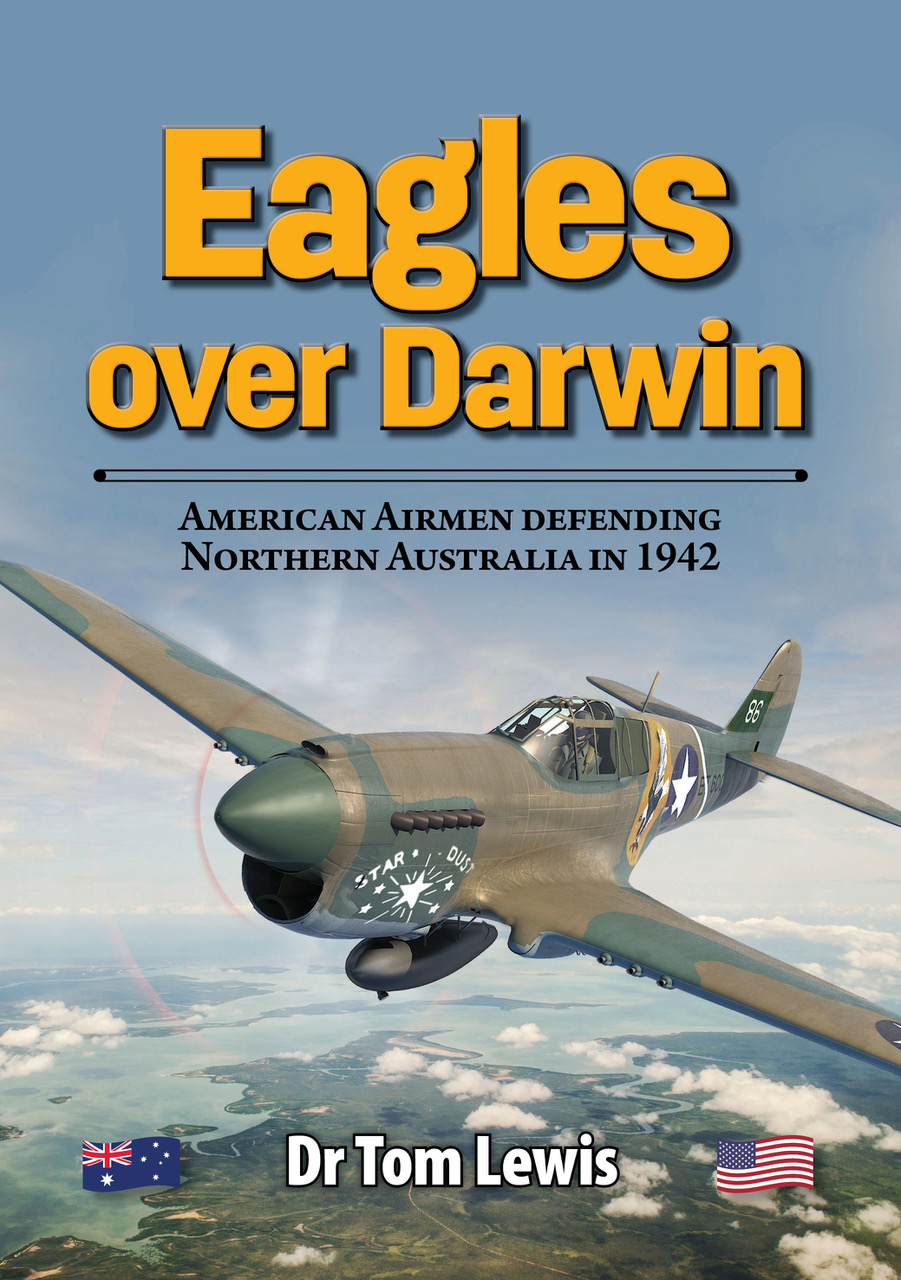
With Eagles over Darwin we see Tom return to the very first air combats over Australia as it and its allies reeled in the face of the Japanese onslaught. From the back cover blurb:


A massive Japanese attack on Darwin on 19 February [1942] had left the town and its air base in ruins. An understrength squadron of USAAC P-40E Warhawks had fought a gallant defence but was all but wiped out.


Northern Australia was now at the mercy of Imperial Japanese Navy Betty bombers and Zero fighters whose crews were both skilled and experienced. However, help was on the way. The 49th Fighter Group was the first such group to be sent from the US after the start of the Pacific War. Its destination was Darwin.


From modest beginnings on make-shift airstrips, the 49th FG entered combat with its feared Japanese adversaries. Its P-40E Warhawks were poor interceptors but were rugged, reliable and well-armed. 


Over several months the 49th FG pilots fought a brave and innovative campaign against a stronger enemy that did much to safeguard Australia in its darkest hour. Today, lonely and long forgotten airfields still bear the name of American pilots who made the ultimate sacrifice.


This is going to be an important book when it's released. I don't think much has been written on the subject, about American Warhawks defending Darwin, for a few years, and the last book I can remember reading on the subject was James Morehead's In My Sights. The most recent work I can think of is the well-regarded Darwin's Air War by Bob Alford. The Ferguson and Pascalis Protect & Avenge is perhaps the largest work on the 49th FG, but, a product of the mid-nineties, it's getting long in the tooth now and can be found wanting. Tom Lewis has been investigating Warhawks ops over Darwin for a while now and uncovering new information that will surprise and, as usual, challenge. A vignette of Australia's defence, and USAAC/USAAF history, very much deserving this treatment.